Heritage Information Sheet - Carports and Garages
Prepared by Authentic Heritage Services Pty Ltd
For properties included in a heritage overlay of the Greater Geelong Planning Scheme, a planning permit is required to construct a carport or a garage.
Most of the Heritage Design Guidelines for heritage areas (Incorporated Plans) in the Planning Scheme encourage rear or recessive side locations for new carports and garages. This is because carports and garages are not traditional elements in 19th and early 20th century urban and residential settings.
Even with the onset of the motor car in the 1920s, garages were modest and usually located at the rear of properties. Careful consideration therefore needs to be given to the design and placement of these structures, having close regard to context of the site and streetscape so that the carport or garage do not undermine the significance or detract from the character and appearance of the heritage dwelling and streetscape.
The Heritage Design Guidelines also list as a primary source the City of Greater Geelong Heritage and Design Guidelines 1997. These Information Sheets have been prepared to further elaborate on the types and locations of carports and garages appropriate in heritage areas.
They are prepared informally only, and do not supersede the Incorporated Plans or the City of Greater Geelong Heritage and Design Guidelines 1997, which should be read in conjunction with these sheets.
Urban and suburban situations
Of critical importance when assessing an application for a new carport, garage, shed or similar structure is whether the traditional character and setting of a property, including open spaces and landscaping has been retained.
Undermining the character and appearance of a place through an ill-conceived location, form or construction of a carport, garage, shed or similar structure can have a negative heritage impact on the heritage place.
Locations
Rear location
Where opportunities exist, new carports, garages, sheds and similar structures should be located at the rear of the property. Every effort should be made for a highly recessive location, utilising rear lanes or existing driveways for vehicular access.
Front location
In most cases, carports, garages, sheds and similar structures should be avoided in front setbacks as they are visually intrusive and atypical to the traditional setting and character of the place.
Existing front carports and garages
Existing introduced and visually intrusive carports and garages should not form a basis for a new replacement outbuilding in the same front or forward location.
Side location
A proposed carport, garage, shed or similar structure located at the side of a dwelling or building should be recessive from the main front wall plane. Ideally, it should be towards the rear (Figure 1).
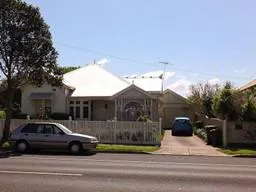
Source: Dr David Rowe.
The City of Greater Geelong Heritage and Design Guidelines state that new carports or garages situated at the side of a dwelling should be placed at least one metre behind the main front wall and have a separate roof form. The Guidelines further state that where possibly they should be placed further back.
Determining the minimum setback will also need to be governed by the front wall planes of the immediately neighbouring dwelling. If the neighbouring dwelling has a greater front setback, consideration should be given to locating the new carport or garage at least one metre behind this neighbouring front wall plane to ensure that the new work is recessive in the streetscape (Figure 2).
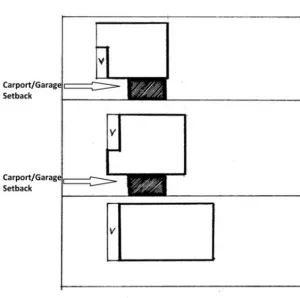
Source: Dr David Rowe.
Corner properties
Generally, corner properties in Greater Geelong are ‘bookends’ to streets. Outbuildings close to the secondary (side) street boundary were not uncommon. Where a carport or garage is proposed to be situated with a frontage to the principal street (like that of the main façade of the dwelling), recessive locations of at least one metre from the front wall plane of the dwelling are encouraged.
Where the carport or garage is proposed to be situated with a frontage to the secondary street (and the main façade of the dwelling fronts onto a principal street), ideally, it should be set back in line with the side wall plane of the dwelling (the wall fronting the secondary street) (Figure 3). At the very least, a one metre setback from the secondary street (side) boundary is encouraged. Ultimately, the setback may be dependent on the integrity of the street, scale and height of the proposed carport or garage and whether the new work will have any visual prominence.
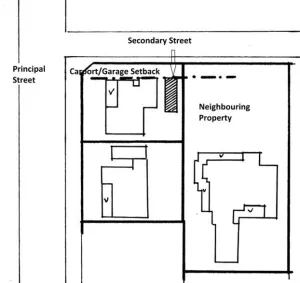
Source: Dr David Rowe.
Scale and design
The scale of a proposed carport or garage should consider:
- A rear location (where not visible from a street or public park) where greater than a single vehicle width.
- A single vehicle width carport or garage for a side location.
- A single vehicle width carport or garage on a corner property where the proposed building will front a secondary street with a minimal setback of at least 1 metre.
- Tandem arrangements (one vehicle behind the other) for accommodation of two vehicles in side or corner locations, particularly where the site may be contextually narrow and where the garage would dominant the site.
Roof form, design and construction
The roof form, design and construction materials for the proposed carport or garage should be drawn from the architectural characteristics of the dwelling but in a contemporary, streamlined way. This is usually a gabled or hipped roof form with similar pitch (Figure 4). In some instances, flat roofs are appropriate, particularly if this will reduce visual prominence.
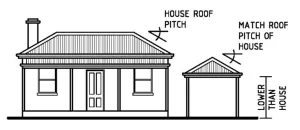
Source: Gary Johnson Architect.
Freestanding compositions for existing dwellings
A freestanding carport or garage is encouraged. Extensions of an existing front verandah or incorporating the new structure as a seamless extension of an existing roof form should be avoided. This outcome undermines the integrity and significance of dwelling or building and diminishes its significance, character and appearance.
Incorporating garaging in new dwellings
While the City’s Heritage and Design Guidelines promote separately-roofed garages for existing and new dwellings, sometimes there may be opportunities for incorporating the garage into the design of a new dwelling in a manner that does not detract from the character and appearance of the heritage area.
This might be through integrating the appearance of the garage component with the fenestration, construction and design detail of the dwelling proper, thereby avoiding otherwise blank elevations atypical in residential heritage streetscapes.
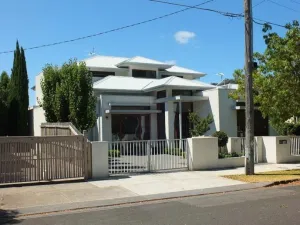
Source: Dr David Rowe.
Secondary effects
Before deciding on the construction of a new carport or garage, consideration needs to be given to whether the location may result in the removal of a significant tree or adversely affect the health of a significant (significant trees are identified in the Schedule to the Heritage Overlay under “tree controls apply”).
The need to alter a significant fence, alter significant kerb and channel and construct a new driveway and/or new cross over may be other implications requiring resolution prior to committing to the carport or garage proposal.