Council generally considers a “Tiny Home” to be a moveable dwelling on wheels, constructed on a chassis (similar to a caravan), or a small relocatable dwelling pod, often prefabricated.
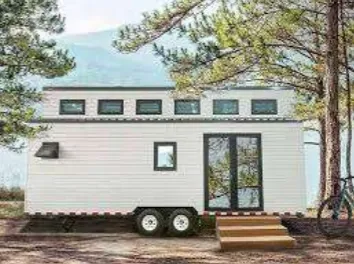
What is a Tiny Home
Under Victorian Legislation there is no formal definition of a Tiny Home.
Regardless of size, any dwelling which is fixed to an allotment and connected to services including water, sewer or electricity, is not considered a Tiny Home and is treated as a permanent building.
What permits do I require to live in a Tiny Home?
You may require a Planning Permit depending on the design and location your Tiny Home. Your proposal might be considered a Small Second Dwelling.
Please feel free to speak to one of our team members today at 5272 4456 or alternatively, come speak to us in-person by booking a meeting.
If you need written confirmation from Council's Planning Department, you can follow one of the links below.
A Building Permit is required if the tiny home or associated structures (eg. Deck, Verandah) are fixed to the ground. Additionally, the dwelling would typically be connected to services (water, electricity, sewer) and be self-contained. Under the building permit process the building must comply with the Building Act 1993, Building Regulations 2018 and the National Construction Code (NCC).
If your tiny home is on wheels and is a registerable vehicle capable of going on a road, then a building permit may not be required, however you may still need a planning permit depending on where the tiny home is located.
Council Environment team can assist with this matter – see onsite wastewater management systems.
Where no other approvals are needed for any of the above you may require a Local Laws permit for camping on land that is not owned by Council or is not a Caravan Park.
It is advisable to check with Council regarding Tiny Homes, starting with reaching out to our Planning Department at 5272 4456.
You can learn more about tiny houses via Australian Tiny House Association.
Related Content
Page last updated:
We are glad that you find this page helpful!
Submitting feedback... Please wait.
An error occured! Please try again.
Feedback submitted successfully!
Thank you for your feedback. We value your input and will use it to improve our services.