Take this journey along the creek and discover the rich diversity of the native flora and the natural habitat it provides for many species of fauna.
Report an issue at a park, reserve or on public land.
Cowies Creek - A brief history
The First nation people ‘Wadawurrung people’ used the creek as a source of fresh water food and medicine. Post settlement the creek was named after John Cowie a saddler from Scotland who made his fortune during the gold rush years and one of the earliest settlers in the area. The creek was primarily used for landing stores and shipping out wool as the creek meanders from Moorabool farming area to the mouth at Corio Bay. The mouth of Cowies Creek was excavated to become Corio Quay.
By 1849 most of the land surrounding the creek had been sold and there is some evidence of the land being used for farming.
During the mid 1970s re-vegetation along Cowies Creek began. There were not many remnants of native vegetation remaining so the best place to find some of these plants were along railway lines and in cemeteries as they were never used for grazing.
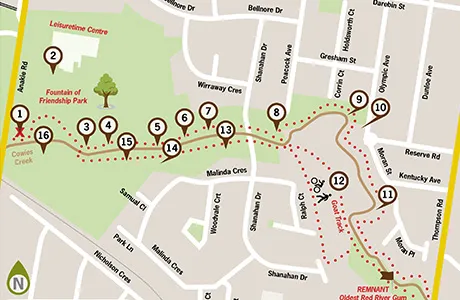
The Cowies Creek Environmental Walk is approximately three kilometres and will take you around 50 minutes to walk it.
Places of interest
A hotel formerly on this site provided patronage to bullock transport that took a day to reach this point and workers constructing the Geelong railway line.
The hotel closed in 1869 and became a family homestead.
Corio Leisuretime Sports Precinct
Leisuretime is Geelong’s largest indoor open spaced stadium with facilities for basketball netball squash volleyball badminton futsal and much more.
Toilet facilities are available here.
Seaberry Salt Bush (Rhagadia candolleana)
A dense scrambling plant with a spray of white flowers and bright red berries which provide food for birds.
Aboriginal people used the berries to dye materials.
Silver Wattle (Acacia dealbata)
A large shrub with feathery silver-grey or bluish leaves.
Produces a small yellow golden fluffy flower balls and a fruit pod that contains several seeds.
Hop Goodenia (Goodenia ovate)
Small shrub with glossy green oval shaped leaves and yellow flowers.
Aboriginal women would rub the leaves with their fingers for the baby to suckle to induce peacefulness and sleep while on their long journeys.
Golden Wattle (Acacia pycnantha)
The flower of this tree has become our National Floral emblem and was formerly adopted in 1988 the year of Australia’s Bicentenary.
Bull Rush (Cumbunji typha
A semi aquatic reed plant with edible roots (rhinzones). The roots were ground and used by Aborigines as flour but needed to be treated carefully as contained toxic elements.
The leaves were woven into many products.
Drooping Sheoak Tree (Allocasuarina verticillata)
This medium sized tree has a male and female variety.
The male tree has yellowy gold drooping flowers that act like salt and pepper shakers and the female tree has red pom pom like flowers on branches.
Yellow Gum (Eucalyptus leucoxylon)
This tree is great for honey production and reaches 10-20 metres in height.
Flowers may be white cream or pink or red.
Late Black Wattle (Acacia mernsii)
In the early 1900’s tannic acid was extracted to use when tanning hides plywood adhesives and antiseptic.
Aborigines used to soak the bark in wooden waddies next to an open fire to extract their own antiseptic and used to grind the wattle seeds a nutritious flour rich in polysaccharides and high in protein.
Water Fern (Azolla)
Is a native aquatic plant found in slow moving water. It is high in protein and minerals and fixes nitrogen.
It can appear red or green depending on the exposure to the sun.
Wetland - Growling Grass Frog (Litoria raniformis)
Cowies Creek and the adjoining wetland areas within the creek reserve provide an important habitat for a range of aquatic fauna including six frog species one of which is the Growling Grass Frog.
Moonah Tree (Melaleuca lanceolate)
Having a life span of 200+ years the trunks of these trees become knarled and twisted creating fascinating shapes.
This tree is an endangered species and provides shelter for many understory plants and habitats for birds and insects.
Hedge Wattle (Acacia Paradoxa)
A small fast growing shrub often called Kangaroo Thorn as it has thorns along its stems with small globular yellow flowers.
Being thorny it provides a nesting place and shelter for many small birds like the Superb Blue and White Brown Scrub Wren.
Tussock Grass (Poa labillardieri)
Grows in clumps with in-rolled hairless leaves. It also has flower heads in spring and summer and is a common grass found along freshwater streams.
A good plant to re-vegetate areas.
Corio Bowl Skate Park
The oldest Skate park in the region with three concrete bowls; beginner intermediate and a 10 foot advanced bowl for the more experienced skaters.
The bowls have always been a hot spot for international professional skateboarders since the 1980s.
The Project
The ‘Knowing your Place School Active Transport’ project is facilitated by the City of Greater Geelong and provides local students with an opportunity to participate in a range of community based projects.
Working directly with a City project officer VCAL students from Covenant College assisted in researching flora fauna and points of interest in the Cowies Creek area to develop a walk/cycle trail.
The students were required to conduct an audit of the loop to assess the walkability of the track. In addition to gaining knowledge and skills around developing a walk/cycle trail the project also provided an insight into how the Wadawurrung people used plants and water at Cowies Creek as a source of food and medicine for survival.
About Covenant College
Drawing students from Geelong and surrounding regions Covenant College is a vibrant active Christian school with a diverse cultural and denominational base. Catering for students from three year old kindergarten through to VCAL/VCE Covenant College also features a Trades Skills Centre.
The students who participated in the Cowies Creek Environmental Loop Walk project are currently working toward their Foundation and Intermediate levels of the Victorian Certificate of Applied Learning (VCAL)
The City of Greater Geelong wishes to acknowledge the efforts of Kelly McKenzie and Jackson Smith VCAL teachers and all of the students from Covenant College who participated in this project.
Covenant College has a diverse cultural and denominational base drawing students from Geelong and broader regions. A vibrant active Christian school that caters for students from 3 year old kindergarten to VCAL/VCE and includes a Trade Skills Centre.
Where
In this section
Karndoor-Kapa TrackPage last updated:
We are glad that you find this page helpful!
Submitting feedback... Please wait.
An error occured! Please try again.
Feedback submitted successfully!
Thank you for your feedback. We value your input and will use it to improve our services.