Frequently asked questions about the permanent closure of the facility to the sale of sheep and cattle.
Frequently asked questions - Geelong Saleyards
Permanent closure
Reports on the operation and potential closure of the Geelong Saleyards have been brought before Council since 1998, with a number of recommendations to close the facility.
In August 2016 the City closed the Geelong Saleyards for sheep and cattle sales due to significant Occupational Health and Safety (OH&S) issues at the site.
Works commenced in November 2016 to enable safe operations of sheep sales only at the facility.
In December 2016 the City’s Administrators resolved to defer a decision on costly cattle yard repair works, and future operations at the Geelong Saleyards, until the completion of an independent local stock market analysis, a full costing of OH&S works on the cattle yards and a regional agribusiness strategy.
The following three key pieces of information, and extensive stakeholder engagement, informed the final decision to permanently close the Geelong Saleyards from 31 August 2017.
- Independent local stock market analysis
In May 2017 the City’s Administrators formally noted the independent Saleyards Livestock Market Analysis Report.
The report highlighted that the saleyards model in Geelong is “not the solution to the challenge of providing a livestock exchange for the demographic existing now and into the future”.
The report noted a 70% decline in cattle numbers through the Geelong Saleyards from 2000 to 2016.
The report is available on our saleyards page.
2. Full costing of OH&S works on the cattle yards
The financial performance of the Geelong Saleyards during the past 10 years has declined, with the last two years resulting in losses of more than $200,000 per annum.
An independent report from Zinc Cost Management estimated that works to repair the cattle yards to an acceptable standard (without a roof) is $2,895,000.
The report is available on our saleyards page.
3. Regional agribusiness strategy
A Sustainable Agribusiness Strategy for the G21 Region, which was endorsed by the Administrators at a Special Meeting of Council on 2 August 2017, noted that of the region’s livestock share, more than three quarters of the livestock comes from outside Greater Geelong’s municipal boundary.
The Sustainable Agribusiness Strategy for the G21 Region is available online.
4. Stakeholder engagement and consultation
Extensive consultation was undertaken to inform the Administrators’ decision to permanently close the Geelong Saleyards.
This consultation included, but was not limited to, engagement with:
- Stock agents
- Transport operators
- Saleyards Users, including the Geelong Saleyards Users Group
- G21 Agribusiness Forum
- G21 Agribusiness Board
- Surf Coast Shire
- Golden Plains Shire
- Colac Otway Shire
- OH&S Consultant
- Traffic Management Consultant
- Ag Concepts Consultants
- North Geelong residents
- Buyers
- State and Federal Government Members of Parliament
- Australian Livestock Saleyards Association
- Livestock Saleyards Association Victoria
- Metalcorp
- Proway
- Department of Economic Development, Jobs, Transport and Resources
- Worksafe
- EPA
- VicHealth
- Barwon Water
- Victorian Farmer’s Federation
- Meat and Livestock Victoria
- Saleyards owners/operators at Colac, Ballarat, Warrnambool, Camperdown, Ouyen, Kyneton, Pakenham, Hamilton, Mansfield, Wangaratta, Forbes and Casterton
- A survey of more than 1400 stakeholders, with 463 responses
- An independently-facilitated workshop, attended by 118 stakeholders
- A Geelong Saleyards Advisory Committee, established in March 2017
- Consultation by Robert Hermann, as part of an analysis of the local stock market.
At a Special Meeting of Council on 2 August 2017 the City’s Administrators resolved to:
- close the Geelong Saleyards to the sale of sheep and cattle by 31 August 2017
- inform neighbouring Councils and stakeholders of the decision to close the Saleyards
- engage with the poultry sales operator, who currently operates at the Geelong Saleyards, to consider and determine the future of poultry sales at Geelong Saleyards site
- engage with representatives of the livestock transport industry to consider and determine the future usage of the truck wash facility at the Geelong Saleyards
- engage with the community to develop a strategy to recognise the history of the Geelong Saleyards
- identify Heritage elements to be retained at the Geelong Saleyards, and to make safe the site by demolishing unsafe infrastructure
- develop a Precinct Plan for the Weddell Road site incorporating the provision of public open space and
- thank the members of the Geelong Saleyards Advisory Committee for their advice and input to the operations of the Geelong Saleyards since March 2017.
No. the truck wash was closed in August 2025 following a Council resolution to sell the Saleyards site.
TThe early Geelong Town Corporation bought land for the saleyards in 1867 and opened the saleyards in 1869.
The Geelong Saleyards operated as a livestock exchange from 1869 until 31 August 2017.
As part of the decision to permanently close the Geelong Saleyards to the sale of sheep and cattle the City’s Administrators resolved to engage with the community to develop a strategy to recognise the history of the Geelong Saleyards.
Council resolved at their 26 August 2025 meeting:
That Council:
1. Note the outcome of the community engagement process in accordance with
section 114 of the Local Government Act 2020 and the Community
Engagement Policy; and
2. Authorise the sale of approximately 4.3-4.5 Ha of the land at 125-135 Weddell
Street, North Geelong known as certificate of title volume 97254 folio 139,
Lot 2 on PS206464.
3. Authorise the Chief Executive Officer or delegate to sign documents to
complete the sale of the land.
Background
The early Geelong Town Corporation bought land for the saleyards in 1867 and opened them in 1869. It operated as a livestock exchange from 1869 till 31 August 2017.
The City of Greater Geelong owns and operated the saleyards, on behalf of all municipal ratepayers.
The City of Greater Geelong is responsible for all costs associated with the saleyards.
In the 2015–2016 financial year, the saleyards budget was $425,000.
Of that, the City allocated about $250,000 for expenses such as contractors, maintenance, utilities, depreciation, plant, and safety works.
No. Over a 10-year period, the City has made an average loss of $171,000 per annum.
In the financial years from 2013-2014 to 2015-2016, the City’s losses have been $194,000, $206,000 and $245,000.
The table below shows the sheep and cattle throughput figures for the Geelong Saleyards from 2003 to 2016. The table indicated the significant decrease in the numbers of sheep sold from 86,101 in 2010 to 45,539 in 2015 which was the last full year of sales.
The cattle sales figures shows a steady decline in sales from 27,080 in 2003 down to 5,151 in 2011 before a slight increase in 2014 and 2015 when farmers were forced to destock due to drought conditions.
| Year | Cattle | Sheep |
|---|---|---|
| 2003 | 27,080 | |
| 2004 | 20,930 | |
| 2005 | 18,675 | |
| 2006 | 17,266 | |
| 2007 | 18,616 | |
| 2008 | 8,987 | |
| 2009 | 8,303 | |
| 2010 | 6,841 | 86,101 |
| 2011 | 5,151 | 72,855 |
| 2012 | 6,584 | 59,929 |
| 2013 | 7,999 | 57,649 |
| 2014 | 10,029 | 50,993 |
| 2015 | 10,878 | 45,539 |
| 2016 | 3,835 | 19,070 |
Of the G21 region's total livestock share, more than three quarters comes from outside Greater Geelong's municipal boundaries.
Despite its age, the Geelong Saleyards is not listed with Heritage Victoria.
However, the site is covered by a City of Greater Geelong Heritage Overlay, as it contains a number of heritage elements.
The City’s Heritage Overlay (HO) over central saleyards area means that the heritage elements of that area must be considered in any permit application for new buildings, or any demolition.
The local stock agents from HF Richardsons and Charles Stewart determined the frequency of sales, and what time they are held.
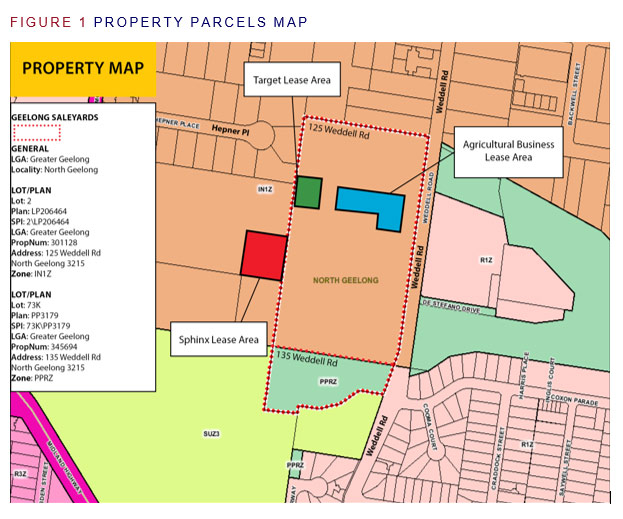
The saleyards occupies two property parcels: 125 Weddell Road and 135 Weddell Road, North Geelong.
The City owns the parcel at 125 Weddell Road, which comprises the northern section of the site in the Industrial 1 Zone (IN1Z).
The parcel at 135 Weddell Road is Crown Land. The southern section of the saleyards occupies this site, which is in the Public Park and Recreation Zone (PPRZ).
- Property Parcels Map
In July 2016, 1500 surveys were sent out to local livestock producers with the cooperation of HF Richardson and Charles Stewart stock agents. A total of 463 surveys were returned, which is a 30% return rate. Eighty six percent of responders reported that they currently sell stock at the Geelong Saleyards, with 42.5% advising that over the past two years they had sold 1-3 times per year. 58.7% of those selling at the Geelong Saleyards are selling sheep, and 69.3% are selling cattle.
When asked if producers sold stock at other saleyards, 42.7% responded yes and 57.3 responded no. Of those who indicated they sell at other saleyards 68% were selling at Ballarat and 55.7% at Colac. 47.9% of responders reported that they transport their own stock, with 52.1% using a transporter.
When asked about their future usage of the saleyards 79.1% indicated their usage would remain the same and 14.4% thought their usage would increase.
This survey was issued and responses received prior to the closure of the Geelong Saleyards due to occupational health and safety issues in August 2016.The data contained within the survey includes comments that identify individuals and companies, and therefore the City is unable to release the full report.
City decisions regarding the saleyards
At its meeting on 9 June 2015, the City’s Council adopted following recommendations:
That Council:
- Seek opportunities for savings in operation of the saleyards;
- Actively identify potential uses of existing land and facilities outside normal saleyards operations;
- Work with neighbouring Councils to identify and develop a suitable regional solution with the view to initiating a future staged withdrawal from saleyards operation.
At a subsequent meeting on 27 September 2016, the City’s Council adopted the following recommendations:
That Council:
- reiterates the resolution of the previous Council, to pursue a staged withdrawal of operations at the Geelong Saleyards;
- notes the extensive consultation undertaken by Council Officers, which included producers, agents, regional saleyard operators and officers of the Surf Coast Shire, Borough of Queenscliffe, Golden Plains Shire and Colac Otway Shire;
- notes that it was unforeseen that the Saleyards would close due to safety concerns before a transition plan was developed for staged withdrawal;
- requests Officers to undertake additional consultation for further consideration at the 22 November 2016 Council meeting.
On 13 December 2016, the City's Administrators adopted the following recommendations:
That Council:
- note the content of the independent OH&S Audit inspection undertaken by SafetyZone (Attachment 4) and the serious range of findings that need to be addressed prior to recommencing cattle sales;
- note that repair works are already underway to enable safe operations for small lot sheep sales at the Geelong Saleyards in January 2017;
- note that repair works on the cattle pens have not commenced and an initial estimate is in excess of $300,000;
- defer repair works on the cattle yards until an independent expert local stock market analysis is completed and a full costing estimate is prepared based on the recently completed OH&S Audit inspection;
- work with buyer, seller, agent and transporter representatives and other related stakeholders immediately to develop interim support arrangements for small lot cattle sales;
- consistent with the previous Council’s resolution of June 2015, work with the G21 group of Councils, the G21 Agribusiness Forum and other agriculture peak bodies to establish an agribusiness strategy for the region which incorporates the resolutions of the Surfcoast Shire Council (see attachment 5) with a view to this being available for a final decision by mid 2017;
- establish a Geelong Saleyards Advisory Committee, with a Terms of Reference consistent with the “Australian Code of Practice for the Selling of Livestock” and work with the proposed Committee to advise Council on user issues at the saleyards.
At a Special Council Meeting on 2 August 2017, the City’s Administrators adopted the following recommendations:
That Council:
- Close the Geelong Saleyards to the sale of sheep and cattle by 31 August 2017;
- Inform neighbouring councils and stakeholders of the decision to close the saleyards;
- Engage with poultry sales operator, who currently operates at the Geelong Saleyards, to consider and determine the future of poultry sales at the Geelong Saleyards site;
- Engage with representatives of the livestock transport industry to consider and determine the future usage of the truck wash facility at the Geelong Saleyards;
- Engage with the community to develop a strategy to recognise the history of the Geelong Saleyards;
- Identify heritage elements to be retained at the Geelong Saleyards, and to make safe the site by demolishing unsafe infrastructure;
- Develop a precinct plan for the Weddell Road site, incorporating the provision of public open space; and,
- Thank the members of the Geelong Saleyards Advisory Committee for their advice and input to the operations of the Geelong Saleyards since March 2017.
Early in August 2016 safety concerns were raised regarding the condition of the saleyards facility.
An engineer's report was received on the overhead and pedestrian walkways and other components including loading ramps which identified risks to users. This prompted immediate temporary closure of the Geelong Saleyards to sheep and cattle sales on 22 August 2016.
Agribusiness in Greater Geelong
At a Council Meeting on 13 December 2016 the City's Administrators adopted the following resolution:
That Council:
6) consistent with the previous Council’s resolution of June 2015, work with the G21 group of Councils, the G21 Agribusiness Forum and other agriculture peak bodies to establish an agribusiness strategy for the region which incorporates the resolutions of the Surfcoast Shire Council (see Attachment 5) with a view to this being available for a final decision by mid 2017;
The City's Administrators adopted the Sustainable Agribusiness Strategy for the G21 Region at a Council Meeting on 2 August 2017.
The City's Administrators formally noted the Saleyards Livestock Market Analysis Report in May, prepared by a firm of independent consultants specialising in agricultural strategy and marketing.
The report was commissioned after the City's Administrators deferred Occupational Health and Safety works on the cattle section of the Geelong Saleyards until further information was provided about the region’s agribusiness sector and local livestock trends.
The key findings of the report are:
- Livestock numbers in Victoria have declined, and across the state they are ‘stagnant at best’.
- Livestock numbers are impacted by broad-acre farming, as well as continued urbanisation in the G21 region.
- Under the existing saleyards model, achieving profitability in small local saleyards is extremely difficult.
- Farms in the Geelong region are becoming smaller, and the livestock sales facilities needed to support smaller scale, or ‘peri-urban’ farming is very different to the traditional model.
- While it is possible to modify the Geelong Saleyards to suit all future requirements, further investigation is needed to identify the most suitable livestock exchange facility for the future.
The report found that rationalisation of saleyards across Victoria was ongoing with other selling options rapidly emerging, including the establishment of new, regional saleyards and online sales of livestock. These options were attracting sellers away from smaller saleyards, the report said.
Works at the saleyardsWorks at the saleyards
The works included:
- Erecting a new retaining wall at the sheep loading ramps
- Improving access from the loading ramps into the holding pens
- Improving access to the ramps via stairs for the truck drivers
- Replacing decayed rails in the required holding pens
- Capping of the (dangerous) metal posts
- Fully enclosing the new trailer/horse float ramp
- New and improved traffic management devices and signage
The works cost more than $200,000 to bring the sheep pens up to acceptabe Occupational Health and Safety standards.
An independent Occupational Health and Safety assessment on the cattle pens made it absolutely clear that this area of the facility is in much worse condition that the City’s first anticipated. They will require significantly more work and expense to ensure they are safe for public access and use.
You can read the independent structural engineer’s report, Occupation Health and Safety reports for sheep and Occupation Health and Safety reports Cattle Pens.
The City removed old decayed timbers from the holding pens, and replaced these with new (and much safer) hardwood rails. None of the removed rails were suitable for reuse due to splitting or decay.
The selling pens contained a large number of old rotten wooden rails that had to be replaced. The cost to replace these rails with new timber was significant, and it was cheaper to replace them with metal sheep panels.
At its meeting on 13 December 2016, the City Council’s Administrators adopted the following resolution:
That Council:
7) establish a Geelong Saleyards Advisory Committee, with a Terms of Reference consistent with the “Australian Code of Practice for the Selling of Livestock” and work with the proposed Committee to advise Council on user issues at the Saleyards.
Eight members were appointed to the new Geelong Saleyards Advisory Committee, with a first meeting held in March 2017.
At a Council Meeting on 2 August 2017 the City's Administrators resolved to permanently close the Geelong Saleyards to the sale of sheep and cattle by 31 August 2017, and to thank the members of the Geelong Saleyards Advisory Committee for their advice and input to the operations of the Geelong Saleyards.
Page last updated: