Three weeks after the news broke, the place was a ghost town.
Gold - what a scoop! - Bronze Stories: Geelong Unearthed
James Esmond arrived at the offices of the Geelong Advertiser with the gold he had found at Clunes. What a scoop!
On 7 July 1851, the Geelong Advertiser broke the news, and on 22 July they revealed the location of his find. Then, in August, came Thomas Hiscock’s lucky find in Buninyong. Madness followed. Within three weeks, 2500 of Geelong’s 9000 residents had left for the goldfields. Thomas Bates, writing to his nephew, described the road from Geelong to Ballarat: ‘lines of hundreds of drays, hand-carts and wagons, horse-carts and wheel-barrows.
Such a sight will never be seen again. All classes left their occupations, took cradle, pick, and shovel, and away to the diggings.’ Those who left their jobs included journalists. One of the Geelong Advertiser’s rivals, Victoria Colonist, had to close shop. The police were kept busy with horse thefts and other crimes.
A spate of abandoned children meant a local orphanage would be required. Prison hulks were brought into Corio Bay to replenish labour. Geelong’s population recovered, growing to 23,000 by 1854, thanks in part to a map printed by Strachan and Co, showing how Geelong was closer to Ballarat than Melbourne—correcting a previous map that had suggested otherwise. It was, after all, why James Esmond had passed through in 1851, on his way to Melbourne to buy iron for a cradle.
Text: Maria Takolander.
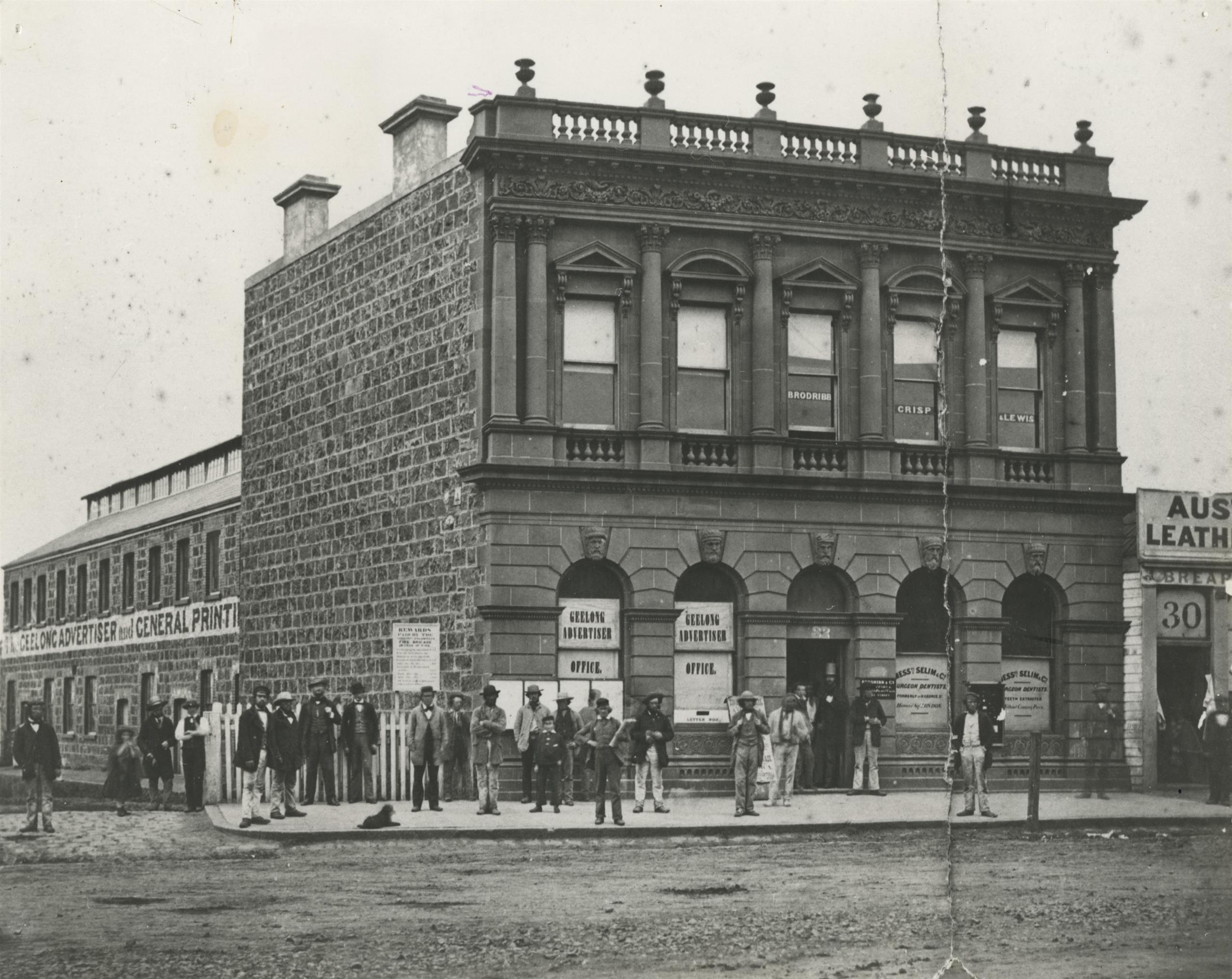
The plaque for this story is located at 27 Malop Street (outside Whyte, Just and Moore), the site of the Geelong Advertiser when it broke news of the gold discoveries in 1851. The building is no longer extant.The photograph here shows the Geelong Advertiser premises elsewhere on Malop Street in 1856.
This story was unearthed with the help of Peter Begg and Ian Wynd’s history of Geelong’s gold rush in The Investigator: Magazine of the Geelong Historical Society.
Mary De Garis
Page last updated: