| Council risk appetite Statement | VERSION | 01 |
| TYPE OF POLICY: | Council | |
| APPROVAL DATE: | 28 October 2025 | |
| REVIEW DATE: | 28 October 2029 | |
| RESPONSIBLE OFFICER: | Manager Enterprise Risk & Insurance | |
| AUTHORISING OFFICER: | Chief Executive Officer | |
Introduction
Risk Management is an essential component of the City of Greater Geelong Council’s governance framework, supporting the achievement of Council’s goals and objectives.
Risk appetite is “the amount and type of risk an organisation is willing to take in pursuit of its objectives”. It represents the balance between potential benefits and threats that come with risk taking. Determining and articulating Council’s risk appetite assists to make better choices by considering risk more effectively in decision making.
While a risk assessment enables Council to understand its risk exposure, it is risk appetite that defines how much risk Council will accept. Only by comparing risk appetite and exposure can Council assess if it is maintaining the right level of risk and appropriately balancing threats with opportunities.
Purpose
The Risk Appetite Statement (RAS) documents the boundaries for acceptable risk-taking to Council by considering the most significant categories of potential risks to Council and outlining how much risk Council is willing to accept in each of those areas. This is described through Qualitative Appetite Statements for each material risk category.
Council is documenting its Risk Appetite Statement at the same time it is adopting the Council Plan 2025-29 as this RAS ensures risk-taking is aligned with Council’s strategic goals and overall objectives.
Benefits
- Supporting conscious and informed risk-taking: By defining how much risk Council is willing to accept, its representatives can make risk informed choices and reduce delays in decision making.
- Promoting more consistent risk management: By defining how much risk Council is willing to accept, it communicates broadly how much risk is acceptable, or indeed desirable, enabling more consistent risk taking.
- Guiding risk decision making and seizing opportunities: The risk appetite statement allows Council’s representatives to better identify opportunities for further risk taking or identify areas where unacceptable risk taking is occurring.
- Structuring the executive conversation on risk taking: The risk appetite statement provides a structured approach to encourage useful debate on what constitutes desirable, acceptable and unacceptable risk.
Scope
This RAS is applicable to all Councillors and Officers of the City of Greater Geelong who are involved in decision making. It covers all business units, including all internal and external facing business units.
Implementation
Council’s appetite for risks, as outlined in the Risk Appetite Statement, forms the basis of its approach to managing risk in its day-to-day activities. The RAS supports the Enterprise Risk Management Policy and Framework which provide the structure for the Council’s risk management system.
All employees are responsible for managing their risk environment. This includes having appropriate controls in place and monitoring their effectiveness. Risks are identified, assessed and managed at both enterprise level (top down) and at operational level (bottom up). Risk registers are used to record and document Council’s risks and risk exposure.
The RAS forms an integral part of decision-making through informed risk-taking. Decisions brought to Council are informed by this RAS. Council reports address alignment with this RAS, ensuring decisions reflect acceptable risk levels and enhancing transparency, accountability, and deliberate decision-making.
Monitoring, Evaluation and Reporting
Regular monitoring allows Council to assess whether it operates within its risk appetite, why it may have decided to go beyond and determines if the set appetite is optimal. This approach recognises risk as an enabler rather than the traditional perspective of risk as a threat to strategic objectives, further supporting Council in the decision-making process.
Risk taking that sit outside appetite or agreed tolerance levels as prescribed by this RAS may be agreed to and should be discussed and agreed by the Risk Steering Committee.
The CEO will provide an annual report to the Audit & Risk Committee and Council, indicating whether the organisation is operating within appetite.
Review
Council formally approves its Risk Appetite Statement as the formally accepted degree of risk that Council is prepared to accept in pursuit of its strategic objectives.
The Audit & Risk Committee provides guidance and oversight of the RAS, reviewing it prior to Council’s endorsement in line with its legislated functions and responsibilities relating to risk management.
A review of the RAS will be undertaken annually, or earlier, in the event of a material change to Council’s risk profile, strategy, operations, or business environment. This review is coordinated by the Manager Enterprise Risk & Insurance, reviewed by the Executive Leadership Team and the Audit & Risk Committee before being presented to Council for endorsement.
The Risk Appetite Statement is formally reviewed and endorsed by Council within 12 months of each new Council term.
Risk Appetite
Integration within Council Strategic Landscape
Council’s risk appetite informs the strategic decision-making process. Council sets its priorities to deliver for the Community in key strategic plans, including the Council Plan, Long-Term Financial Plan, Strategic Asset Management Plan and Strategic Workforce Management Plan. Council has developed its risk appetite to balance the achievement of its strategic goals with the risks inherent in the environments in which it operates, as illustrated by the below diagram.
Risk Categories
In considering its appetite for risk, Council has identified the different categories of risk that can have a significant impact on its ability to meet its strategic objectives and derail its business plans.
Council has identified nine (9) risk categories which will be reviewed at the same time it reviews its risk appetite to confirm their currency. These categories are:
| Assets | Operations & Service Delivery | Health Safety & Wellbeing |
| Environmental & Waste | Community | Regulatory, Legal & Governance |
| Financial | Information Technology & Data | Culture & Capability |
Risk Appetite Scale
A four-level risk appetite scale is established as described below:
- Comfortable: High appetite for risk. Willing to consider options offering potentially higher rewards despite elevated levels of risk.
- Balanced: Moderate appetite for risk. Willing to consider options that may incur risk where significant benefit is possible.
- Cautious: Low appetite for risk. Preference for safe options that may impact potential for reward.
- Risk adverse: Very low to no appetite for risk. Preference to avoid risk rather than pursue potential reward.
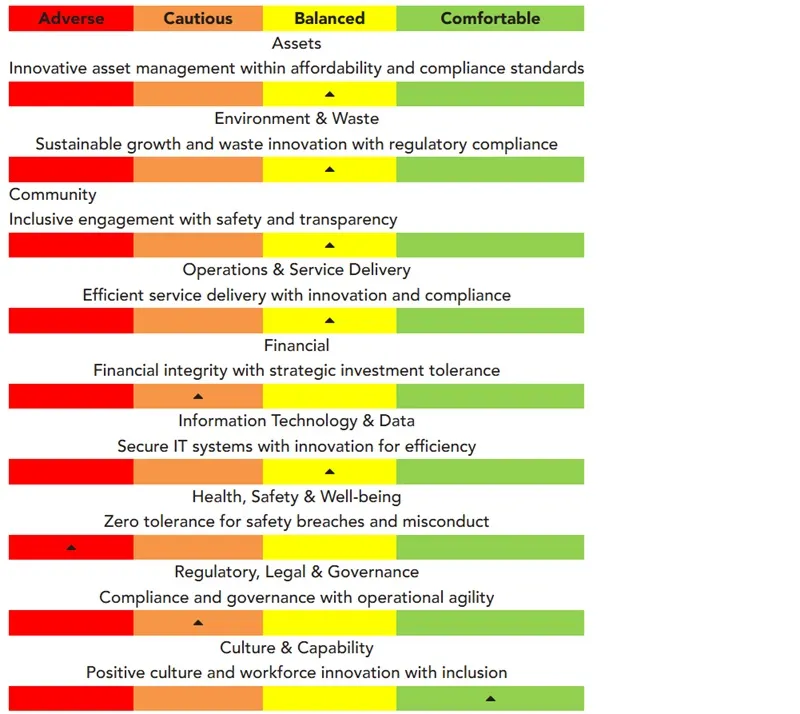
For each of the nine risk categories, the range of appetite as well as a qualitative appetite statement is defined to steer Council in its decision-making process. The statements describe key considerations for pursuing risks, including strategic benefits and limits for potential adverse impacts.
Overall Risk Appetite Statement
The City of Greater Geelong Council adopts a balanced risk appetite, reflecting its commitment to responsible governance, community wellbeing, and long-term sustainability. Council will consider options and activities that are safe and financially sustainable, that also may maximise its ability to innovate and deliver strategic priorities, while caring for the safety and wellbeing of staff and community and providing an acceptable level of service and value for the community it serves and for local government.
While Council’s overall appetite is ‘Balanced’, an appetite level has been determined for each of the nine risk categories to outline Council’s tolerance for risk in the different activities it undertakes. For example, Council’s tolerance for risk in relation to health and safety is very low; hence a highly cautious ‘Risk Adverse’ appetite for that category. On the other hand, tolerance for risk in service delivery is higher, with a ‘Balanced’ appetite. Activities and decisions undertaken by Council must be considered individually according to the relevant risk categories and their associated risk appetite level.
| Risk categories Objectives | Risk Appetite Level | Qualitative Appetite Statement | Tensions / challenges |
|---|---|---|---|
| Assets To ensure that assets are safe, reliable, sustainable, and fit for purpose while meeting community needs. | Balanced | Council has a degree of appetite for innovative solutions to manage its assets portfolio which will deliver community value (social, economic, environmental, cultural and health & well-being) over time whilst maintaining a healthy portfolio of assets within affordability limits. Council commits to maintain assets structurally safe to use and to meet the applicable compliance standards. | Balancing budget prioritisation and community expectations with the need for substantial investment in new, existing and ageing infrastructure. Prioritising resources for renewal and upgrade projects over new construction unless aligned with growth areas or asset consolidation. Managing operational disruptions caused by construction and maintenance against the need for safe, reliable infrastructure. Navigating political tension around funding priorities, ensuring appropriate allocation between new developments and maintaining existing infrastructure. Addressing challenges related to ESD (Environmental Sustainable Design) policies, climate change resilience and the city’s design standards while managing lifecycle costs. Resolving maintenance costs for gifted or underutilised assets and ensuring they align with long-term strategic goals. Addressing scope creep and the balance with Council’s financial capacity. |
| Environmental & Waste To sustain the natural environment while managing growth, reducing non resourced waste, addressing climate resilience, and managing and/or responding to State and Federal regulatory agencies. | Balanced | Council has a degree of appetite for innovative solutions to limit its impact on the environment from its growth and activities. It has no appetite for activities that may lead to material breach of environmental regulations or standards. Council has a degree of appetite for risks associated with new ways to manage its increasing waste volume while fostering the circular economy. | Balancing environmental preservation with economic growth and development needs. Addressing affordability concerns related to Northern growth corridor, infrastructure capacity, and drainage requirements. Ensuring cultural and heritage protection, balancing First Nations heritage risks with mandatory compliance for listed heritage sites. Managing the use of public land for fire protection, buffer zones, and other state intervention needs. Navigating political overlays, flood overlays, and redevelopment in areas subject to inundation or sea level rise. Managing waste as a mini business, exploring revenue generation opportunities versus the risk of impacted service delivery. Ensuring innovative waste management practices that enhance circular economy participation while avoiding high long-term maintenance costs. |
| Community To positively engage with the community by fostering an inclusive, safe environment that considers the diverse needs and expectations of individuals and groups. | Balanced | Council has an appetite for improving social cohesion, strengthening equity, and fostering a positive environment through inclusive, engaging and effective initiatives. Council also has an appetite for equitable resource allocation and service delivery for the community. Council is open to delivering innovative community events and facilitating diverse community engagement, however it has no appetite for risks that compromise community safety particularly at public events, or activities that fail to meet transparency and accountability standards or steer Council away from the Council Plan. | Balancing community expectations for quality services and events with budget and operational prioritization. Ensuring equitable access to resources across diverse groups and addressing varying community preferences. Juggling differing community needs and maintaining consistency in service delivery and outcomes. Addressing safety concerns at events while fostering community connection through innovative and engaging events. Promoting transparency and inclusivity versus managing resource constraints and operational priorities. Striking the right balance communicating with the community by utilizing social media effectively. |
| Operations and Service Delivery To ensure efficient and effective delivery of services that meets the needs of the community. | Balanced | Council is open to creative and innovative ways to operate and deliver its services and is willing to tolerate some level of risk when investing in methods to deliver efficiencies, enhance capabilities and strengthen the community’s experience, or deliver mandatory services where there is a market gap or strategic intention. Council has no appetite for risks that compromise mandatory service delivery, which lead to financial instability, or breach legislative and regulatory requirements. Council maintenance activities priorities are risk based and delivered as per defined and affordable service level. | Balancing cost-shifting from other government levels with local government capacity. Managing in-house operations versus contracting out services and maintaining control. Managing risks of loss of revenue and the cost of outsourcing services. Managing financial capacity versus community needs and expectations. Balancing financial position when addressing a market failure (e.g., providing services where private operators cannot). Managing legislative changes with increased regulatory standards and financial capacity. Ensuring efficient operations without compromising community satisfaction. |
| Financial To ensure Councils’ finances are sustainably managed to fund the continual delivery of BAU operations and strategic projects, so that Council can achieve its internal and external objectives. | Cautious | Council has no appetite for risks that compromise financial integrity including the misuse or ineffective use of funds or where decisions negatively impact the City’s financial sustainability in the long term. Council will tolerate some financial risk relating to investing in innovative projects or services that deliver long-term benefits to the community or COGG as an organisation. Council will tolerate some risks to manage innovatively its property portfolio where there is long-term financial benefit. | Balancing financial flexibility with affordability and the need to meet growing community expectations. Managing increased costs of servicing and balancing political promises with financial constraints. Defining a balanced budget that allows for contingencies while avoiding unnecessary risks in Capex and Opex. Advocating for equitable community growth across different and competing growth profiles within Greater Geelong. Balancing workforce capacity with the growth of servicing and associated costs. Balancing request for Capex grants with community benefits and Council contribution level and financial sustainability. Ensuring accountability, external reporting, and procurement standards while mitigating fraud and corruption. |
| Information Technology & Data To ensure the integrity, availability and security of IT systems to support Council operations while fostering innovation and efficiency. | Balanced | Council has no appetite for risks related to critical IT infrastructure failures, data privacy or cybersecurity breaches, or inadequate backup systems. As a result, Council has no appetite for keeping systems that have reached their end of life and may expose its data availability, confidentiality, and integrity and disrupt critical business services. Council can tolerate a degree of appetite for controlled risks when adopting new systems or enhancements where they improve operational efficiency or customer experience. | Balancing innovation and efficiency with maintaining strong cybersecurity. Securing data and maintaining compliance under Victorian Public Sector regulations versus budget prioritization. Community expectations for service-based technological experiences versus budget prioritization. Managing speed/agility in business operations versus the cost of investment in technology. Adopting new technologies while addressing learning curves and operational disruptions. Balancing cultural alignment and residual risks versus financial investments in IT systems. Accepting controlled risks for enterprise platforms versus minimal risk appetite for critical IT infrastructure. |
| Health, Safety & Wellbeing To ensure the safety and wellbeing of Council’s diverse community and workforce. The City aims to create a safe environment while empowering staff and streamlining processes where appropriate. | Adverse | Council has no appetite for non-compliance with applicable safety regulations or for risks that compromise child safety or have a serious impact on public safety, the health of staff, volunteers or users of community services. Council has no appetite for poor behaviours and misconduct from Officers, Councillors or any other Council representative. Council can tolerate conducting activities presenting high safety risks when covered by policies and procedures that define the approach to safety. Council acknowledges risks associated with emergency situations and that some elements may be outside its direct control. It will remain compliant with its obligations to prepare for and manage emergency situations. | Council has no appetite for non-compliance with applicable safety regulations or for risks that compromise child safety or have a serious impact on public safety, the health of staff, volunteers or users of community services. Council has no appetite for poor behaviours and misconduct from Officers, Councillors or any other Council representative. Council can tolerate conducting activities presenting high safety risks when covered by policies and procedures that define the approach to safety. Council acknowledges risks associated with emergency situations and that some elements may be outside its direct control. It will remain compliant with its obligations to prepare for and manage emergency situations. |
| Regulatory, Legal & Governance To ensure Council complies with all legal and regulatory requirements while fostering innovation within established boundaries. | Cautious | Council has no appetite for risks that result in material non-compliance of legislation or regulatory requirements. Council has no appetite for actions that compromise integrity and good governance of Council’s decisions. There is some tolerance for calculated risks that enhance operational efficiency or decision-making agility, provided they align with legal frameworks and foster an environment of accountability and transparency. | Innovating and taking calculated risks to improve Council against its assigned metrics while staying within legal and regulatory bounds. Balancing regulatory compliance costs with budgets and operational efficiency. Managing potential lawsuits and threats of litigation versus the benefits of streamlined processes. Promoting public trust and reputation versus operational constraints. Balancing no appetite for material non-compliance with the difficulty of meeting every instance of compliance. |
| Culture and Capability To ensure high-quality services and community experiences by fostering a motivating workplace culture, supporting employee engagement, development and retention, and managing talent effectively within capacity and capability constraints. | Comfortable | Council has an appetite for activities that support a positive workplace culture, enhance employee satisfaction and productivity, address labour shortages, and reduce dependency on key individuals. Council will take some risk in developing innovative workforce strategies provided they are well-managed to mitigate reputational or financial harm. Council has no appetite for activities that compromise its commitment to workforce diversity and inclusion. | Managing workforce capacity and avoiding key person dependencies while mitigating potential reputational and financial risks. Balancing training and staff development versus maintaining high standards of service. Addressing labor shortages while maintaining high standards of service. Prioritizing long-term talent development versus immediate operational needs. Collaborating with unions to address workforce challenges versus maintaining operational flexibility. |
Risk Appetite Dashboard