If you plan to build or replace a fence along a shared boundary, you should discuss the matter with your neighbour or alternatively write them a letter.
Fences and retaining walls
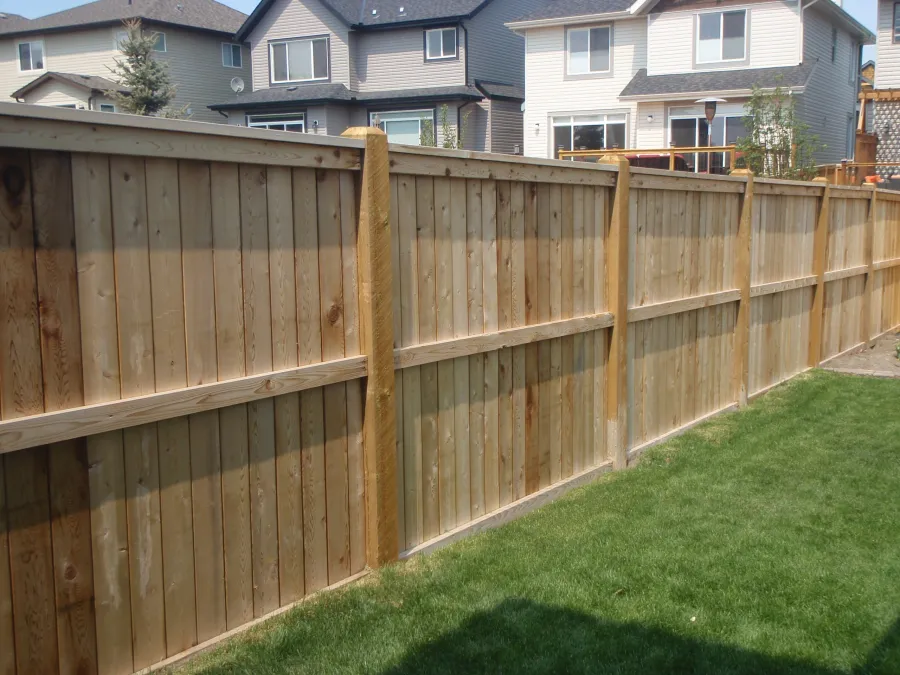
Fencing Law in Victorian is governed by the Fences Act 1968 and the Building Regulations 2018.
The Fences Act contains rules about who pays for dividing fences, the types of fences which can be built, and the process for neighbours to install and repair dividing fences on their land.
The Building Regulations determine which fences require building permits and which are exempted from needing a permit.
For new development areas often there are landscape guidelines which need to be adhered to.
How do I ...
You can apply for a Property Owner Details application. By completing this form you are requesting adjoining ownership details for the purposes of erecting a fence on a boundary in accordance with the Fencing Act 1968 (Vic).
You will need to be the owner of the adjoining property to obtain this information.
Application Process
You can request this information via one of our Customer Service Centres or by completing an online request.
Note this is a fee-paying service and you will require a credit card to complete the online transaction.
https://www.geelongaustralia.com.au/ct/forms/form.aspx?form_id=20165
How long before I receive a response
It may take between three and five working days for you to receive a response. If you need the information quickly, we can provide the information on-the-spot at our Customer Service Centres.
What will I receive
Under section 14 of the Fences Act we can only provide you with the name and address of the owner.
Council does not have the authority to mediate fencing disputes between private property owners. If you are having a fencing issue with another property owner, please visit the Dispute Settlement Centre of Victoria website for more information about your options for resolving the dispute.
The City will not contribute towards the costs to erect a new dividing fence or repair/replace an existing dividing fence abutting City-owned or managed public parks or public reserves.
Reserves include but are not limited to public parks, public reserves, road reserves, drainage reserves, and recreation reserves.
In this case, all dividing fence costs are a private landowner’s responsibility.
Subject to our written pre-approval, we may contribute up to half the cost to erect a new dividing fence or repair/replace an existing dividing fence abutting City-owned car parks and community facilities.
Where the City will contribute towards the cost of fencing, we will pay half the cost:
- for a standard timber paling fence to a height of 1.65 metres
- towards demolition and removal of the existing fence
- based on the lowest-price quote
Any fence outside this standard requires our pre-approval in writing. Any additional costs associated with an above standard fence are a private landowner's responsibility.
Check you are eligible
Under the Fences Act, the City are not required to contribute funding towards dividing fences abutting City-owned or managed land that is a public park or public reserve.
We may contribute towards the costs for fences abutting City-owned car parks and community facilities which are not located on land designated as a public park or public reserve.
Make Contact
Contact us to find out if we will contribute towards the costs for a fence and (if so) to obtain a list of approved fencing contractors – please remember to include the property address and your contact details in your enquiry.
Obtain Quotes
Obtain written quotes from two of our approved fencing contractors.
Submit Information
Submit a request via email seeking our written approval to proceed – please remember to include the property address, owner contact details and the two quotes:
- For approved fences abutting community facilities (including associated car parks), please email our Facilities Maintenance team
- For approved fences abutting car parks (not associated with community facilities), please email our Civil Infrastructure Planning team
What happens next
After reviewing the request and quotes, we will respond in writing advising that your application has been:
- approved, including our financial contribution and the fencing contractor approved to do the work
- declined, including the reasons for our decision
Who organises the works to happen
Once you receive our approval in writing, please:
- contact the approved fencing contractor to arrange for the work to be undertaken at your convenience
- provide the approved fencing contractor with a copy of our approval letter – they will need to attach it to their invoice
How does payment happen
Property owners are responsible for paying their contribution directly to the fencing contractor. When the fence works have been completed, the fencing contractor will forward an invoice directly to the City for payment of our contribution.
ALERT: We will not reimburse private property owners for any costs.
Council does not reimburse private property owners for any costs relating to fencing
What do I do....
Council does not have the authority to mediate fencing disputes between private property owners. If you are having a fencing issue with another property owner, please visit the Dispute Settlement Centre of Victoria website for more information about your options for resolving the dispute.
If a tree is overhanging your property from a neighbour’s property, please contact your neighbour directly. This is not a Council’s responsibility, unless advice is required to determine if the tree is a protected species.
To learn more about your rights and obligations visit the Disputes Settlement Victoria Site.
Rules around constructing fences
You firstly need to determine if you will require a building or planning permit and discuss the proposed fence with any neighbours who share the same boundary.
You need a building permit when:
- Installing a side or rear boundary fence more than 2m high.
- Installing a front fence which is more than 1.5m high and is within 3.0m of the street.
- Installing a corner fence that is more than 1.0m high and is within 9.0m of intersecting streets.
- Constructing any brick or masonry fence more than 1.2m high.
- Constructing a retaining wall higher than 1m.
You don’t need a building permit to build:
- A fence on the side or back of your property that’s up to 2.0m tall. If it’s within 3.0m of the front street, it can’t be more than 1.5m tall.
- A brick fence in the front that’s not more than 1.2m tall and is at least 9m away from where two streets meet.
- A wooden fence in the front that’s not more than 1.5m tall and is at least 9m away from where two streets meet.
- A chain wire fence around a tennis court
A planning permit may be required for a fence or retaining wall, depending on the applicable zone, overlay or other planning controls. An example is in a Heritage Overlay which will require certain heights and design of fences.
Permit requirements may also arise from an approved development or subdivision, including conditions relating to fencing, landscaping and retaining walls.
The City provides a information sheet with visual guides to assist customers who are required or would like to build front fences in a heritage style.
Heritage Information Sheet - Fences | City of Greater Geelong
Most front fences over 1.5m in height will also require a council report and consent.
Where the Building Surveyor deems it relevant a Report and Consent is required where precautions project beyond the street alignment.
A Street Occupation permit is required where works are undertaken beyond the property boundary. This could be using the footpath or nature strip to store materials, using scaffold or temporary fencing.
Retaining walls are designed to hold back filling soil or to support excavation work. You may need a Planning Permit and in some cases a Building Permit.
Retaining walls less than 1 metre in height are exempt from building permits unless they are associated with other building work or with the protection of an adjoining property.
If you are completing a larger project with a building permit, your retaining wall must be included in your building permit.
Most side and rear boundary fences in Victoria can be built up to 2.0 metres high without requiring a building permit. If you are planning a fence higher than 2.0 metres, you should check whether a permit is required before commencing work. This also extends to include anything secured to the fence that would increase the overall height, such as fence extensions.
The overall height of the fence is what determines whether a building permit is required.
For example, if an existing fence is 1.8 metres high and a 400mm extension is added, the total height would increase to 2.2 metres. In these situations, you should contact your local council or a registered building surveyor to determine whether a building permit is required.
Neighbourly Responsiblity:
The overall height of the fence is what determines whether a building permit is required.
For example, if an existing fence is 1.8 metres high and a 400mm extension is added, the total height would increase to 2.2 metres. In these situations, you should contact your local council or a registered building surveyor to determine whether a building permit is required.
Neighbourly Responsiblity:
- Joint Ownership: Dividing fences belong to both property owners under Victorian law, please keep this in mind before making any decisions around shared assets.
- Talk First: You should discuss any changes with your neighbour before you start.
- Cost Sharing: Neighbours share costs for a basic, sufficient fence. If you want an extension just for your own privacy, your neighbour may not be required to pay for it.
Most fencing disputes between neighbours are considered civil matters. While Council may be able to provide general information and guidance on available options to help resolve the matter, it does not intervene or mediate fencing disputes between property owners.
All fences that form part of a swimming pool barrier (including boundary fences or a fence forming part of outdoor play space associated with children’s services) do require a building permit. The minimum height is 1.2m. There are specific construction requirements refer to the Building Code of Australia Volume 2 Australian Standard 1926.1-2012
Find out more about swimming pools and spas.
How to work out the point of intersection
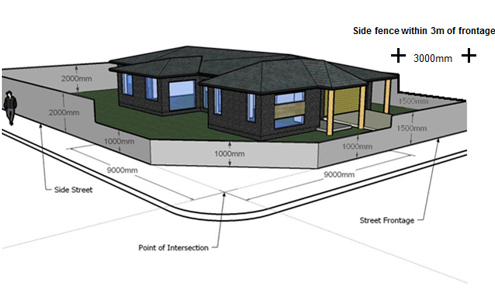
Point of intersection
Page last updated: