Please note: in relation to tree planting guidelines, locations of existing utilities networks must be obtained from Dial Before You Dig. Telephone 1100 prior to any excavation taking place on public land.
Tree management and protection
Tree Planting for new development sites
- Generally, one street tree should be planted in the centre of each residential allotment.
- Where practical, provide consistent, equal spacing between trees and place trees centrally in the nature strip.
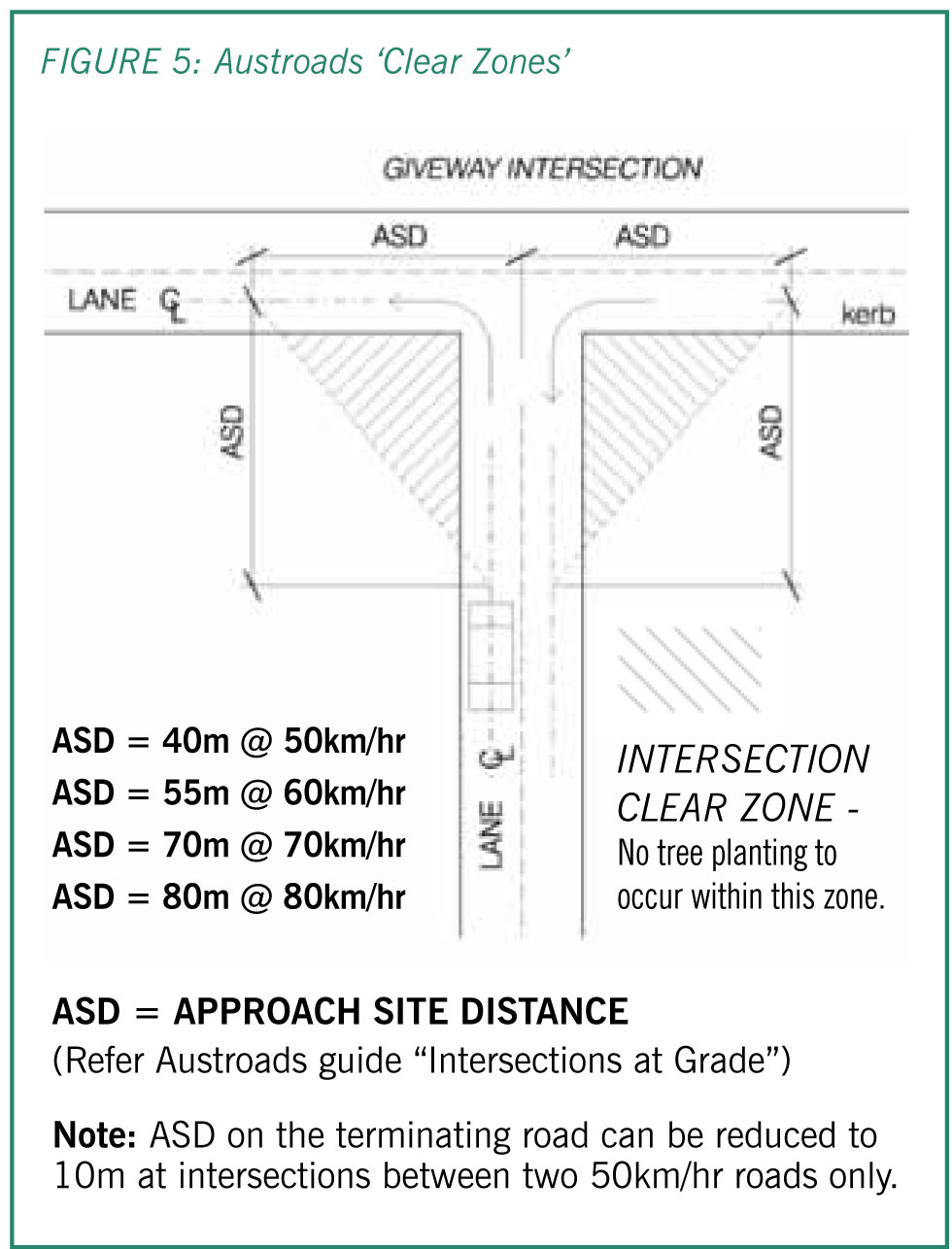
- Street tree placement on side boundaries of properties must meet the requirements of section 5.7 Intersection Site Distances and Clear Zones.
- Street tree numbers and species proposed for side boundaries of properties may be subject to additional requirements. Generally a maximum of two trees will be approved.
- Where the allotment is to be used for unit development and a central crossover is proposed, place a street tree on either side of the crossover if practicable.
- Trees in parks and reserves must be located at least 3 metres apart and 3 metres from garden beds and fixed structures to allow for future mowing. Trees may be planted closer than this in mulched clumps.
- Plans shall be prepared taking into account surrounding hard infrastructure and services however, every site is subject to ‘ground-truthing’ and it is acknowledged that changes may be required as a result.
- Proposed mulch must meet Council standards and be placed around the tree in accordance with the specification shown in figure 4.
Tree Planting specifications
When selecting trees to be planted, it is the responsibility of the Site Superintendent to ensure that all stock meets the requirements shown on the endorsed landscape / streetscape plans.
Unless otherwise agreed, all street trees must be in a minimum 45 litre sized container and be 1.5 metres tall depending on the tree species.
Tree stock must be in a sound and healthy condition and be self-supporting wherever practicable. Should the Site Superintendent wish for our Representative to inspect stock prior to delivery, then contact must be made with the Council Representative within reasonable timeframes to allow this to occur.
Indigenous stock: where indigenous trees are to be used they must be pre-ordered well in advance to ensure supply numbers and pot sizes are achievable.
Tree sizes: Tree stock selected for planting within each street and reserve must be of a minimum container size suitable for each particular landscape treatment.
Expected stock and pot sizes are listed in the table below.
Table 2: Tree stock minimum planting size
| Use/Location | Minimum size |
|---|---|
| Street | 45 litre pot/ 1.5 metres high. |
| Reserves less than 1 hectare | 300 millimetre pot/ 1 metre high. |
| Reserves greater than 1 hectare | Smaller stock may be used (subject to negotiation). |
| Iconic/specimen trees | 150 litre pot (subject to negotiation). |
| Shrubs | 150 millimetre pot. |
Figure 4: Tree planting detail
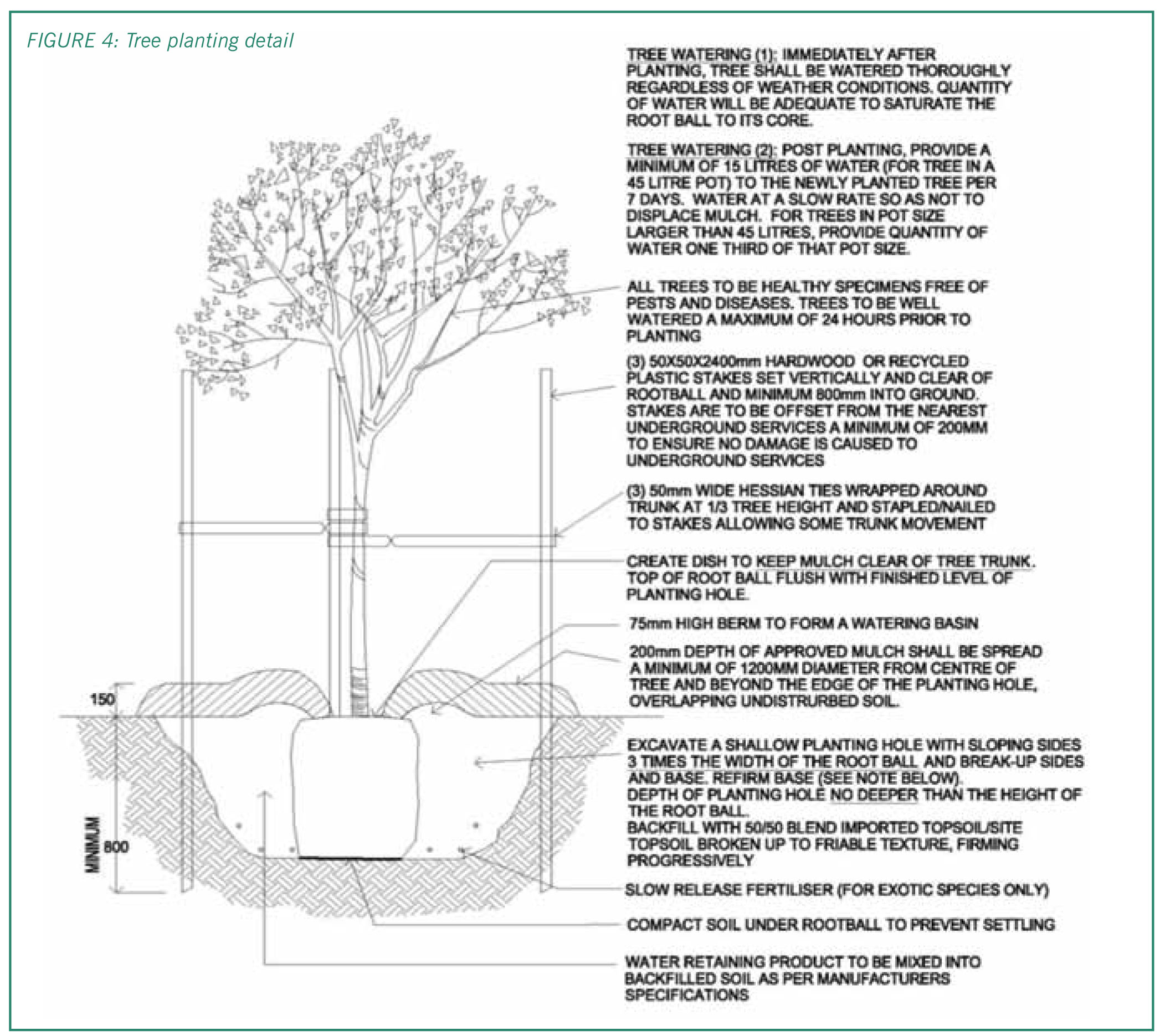
Note: It is the responsibility of the contractor to confirm the location of all underground services prior to commencement of any excavation or staking works.
Street tree offsets/clearances
- 3 metres from pedestrian pathways in reserves (species dependant).
- 3 metres from driveways (species dependant).
- 4 metres from power poles.
- 4 metres from light poles (species dependant).
- 3 metres from service assets, including junction boxes, pits etc.
- 2 metres from service conduit crossing.
- 3 metres from fire plugs.
- 2 metres from domestic service tapping points.
- 2 metres from stormwater outlet points.
Distances provided may be subject to change dependant upon the site and species selected.
Hold points (trees)
Once a site has been marked out for planting, contact shall be made with the Tree Management Council Representative to arrange an inspection and provide authorisation to proceed with planting works. Our Representative should be provided seven working days' notice to ensure that the site visit can be pre-arranged.
During the course of planting, should any unforeseen circumstances arise, or a particular request is received contact shall be made with the Tree Management Council Representative to inspect and authorise any nominated changes.
We will endeavour to provide a prompt response to any queries or concerns whilst having regard to the size of the site and the anticipated timeframe for the completion of planting works.
Tree species substitution/sourcing issues
Whilst it is acknowledged that from time to time sourcing particular stock at certain sizes can be difficult, the substitution of tree stock and installation size is not permitted without the prior authorisation of the Tree Management Council Representative. Stock substituted without authorisation will not be accepted at Practical Completion.
It is the responsibility of the Site Superintendent to raise any concerns or issues relating to the supply of stock with the Tree Management Council Representative as soon as is practicable.
Tree staking
Please note: locations of existing utilities networks must be obtained from Dial Before You Dig Telephone: 1100 prior to any excavation on public land.
Wooden stakes must only be used. Metal stakes or star pickets will be not approved for use in any location. It is preferable that tree ties are hessian banding however nylon banding may be used by negotiation. Tree ties must be secured to each of the stakes. ‘Shoe string’ or nylon interlocking type ties will not be approved for use.
Residential Streets: dependant upon the size and species involved, two stakes may only be required.
Industrial Estates: tree stakes should be a minimum of 75 millimetres x 75 millimetres x 2400 millimetres and use three stakes.
Intersection site distances and clear zones
The diagrams below are the Austroads guide to ‘Clear Zones’ at road intersections. For traffic safety, the Approach Distances (ASD) shown should be retained in all instances where the speed limit on the major road is 60 kilometres per hour or above.
However, the vast majority of intersections are on low speed residential roads where the speed limit is restricted to 50 kilometres per hour.
In this instance, the distance may be safely reduced to 10 metres.
Figure 5: Austroads ‘Clear Zones’
Tree maintenance during maintenance period
All streetscapes and landscapes must be maintained to the satisfaction of the Responsible Authority for a minimum period of two years however this timeframe may be extended by negotiation with us.
The Site Superintendent is responsible for all maintenance on the site during the maintenance period.
- All tree pruning shall be carried out by appropriately trained horticultural/arboriculture staff.
- Tree pruning must be carried out in accordance with AS 4373-2007 Pruning of Amenity Trees.
- At no stage should any more than 30% of the existing canopy foliage be removed at any given time.
- Advice must be obtained from the Tree Management Council Representative where any doubt arises in relation to tree pruning. Uplifting the canopy of trees can only be performed with the approval of the Tree Management Council Representative.
The Site Superintendent must provide a signed and dated Maintenance Checklist, as per the City of Greater Geelong Landscape Standards Manual, to a Council Representative every three months during the maintenance period. Failure to adhere to this requirement may result in the maintenance period being extended.
Our Representatives will regularly inspect the site during the maintenance period, and any defects will be communicated to the Site Superintendent in writing. Works must then be completed within two weeks or as agreed by our Representative.
Trees not meeting the required standard at the date of the expected handover date will have their maintenance period extended. Evidence (that is: date of replanting) must be provided to the Council Representative as part of the quarterly report.
Note: replacement planting undertaken immediately prior to handover will not be accepted and will be subject to an extension of the maintenance period.
We will not accept inappropriate maintenance regimes and standards. Failure to adhere to standards may result in the extension of the maintenance period. We may utilise maintenance bonds if required in order to engage contractors to fulfil the outstanding requirements.
Tree protection and requirements for internal projects
Existing trees to be retained shall be protected on construction sites as follows, and in accordance with AS 4970 – 2025 Protection of Trees on Development Sites:
- At the draft stage of the project, a Preliminary Tree Assessment will be required. The preliminary tree assessment should take place at the beginning of the project after site surveys have been completed. This assessment aims to provide quantitative and qualitative information on the trees. All trees located on the site survey should be numbered and assessed by the project arborist to recommend which trees are suitable for retention.
- Preliminary Arboricultural Report (PAR) s intended to be used by planners, architects and designers, in conjunction with any planning controls and other legislation, to develop the design layout so that trees that are to be retained are provided with enough space. The report shall be prepared by the project arborist. The report should include the findings of the preliminary tree assessment. Trees (or groups of trees) should be placed into
categories based on their suitability for retention. A drawing should be prepared showing all trees and their NRZs, as well as trees recommended for removal irrespective of development. The method used to determine the retention value of all the trees should be documented in the PAR. The NRZs of all trees shall be calculated. - Arboricultural Impact Assessment (AIA) Where works will occur in the NRZ of one or more trees an AIA report shall be prepared by the project arborist once the final development design (layout) is complete. The AIA report shall identify and discuss —
(a) likely impacts on all trees;
(b) design modifications that have been considered;
(c) justifications for trees requiring removal; and
(d) any methods that should be implemented to minimize or avoid the impacts on trees that are to be retained.
The AIA report shall determine the TPZ that it will be possible to protect during site works, for each tree or group of trees. In preparing an AIA, a review of architectural, hydraulic, civil and bulk earthwork, services and landscape documentation should be included to provide an accurate impact assessment. Where these documents are not available for review, this should be clearly stated in the report. The AIA report shall discuss and propose design and construction methods to minimize impacts on retained trees and outline the management and protection methods necessary to minimize impacts on the tree or trees. - Tree Protection Specifications (TPS) and Tree Protection Plan (TPP), these documents shall be prepared by the project arborist and consider measures necessary to protect and manage the trees throughout all stages of the development. The most current version of the TPS and TPP shall be included in the construction documentation.
The TPS shall:
(a) specify, using a logical and sequential process, the measures by which the trees will be
protected and managed throughout the development works;
(b) state any prohibitions that may be required due to the lack of detail or documentation (e.g. no
trenching is allowed within the TPZ where a services plan does not exist); and
(c) document critical stages.
A TPP, including a scale or dimensions, shall show:
(i) TPZs for trees being retained,
(ii) the location of specified tree protection devices. - Activities generally excluded from the TPZ include but are not limited to the following:
(a) Excavation, cultivation or disturbance of the soil, including scraping of the surface.
(b) Equipment and material storage.
(c) Preparation of chemicals, including preparation of cement products.
(d) Movement or parking of vehicles and plant.
(e) Dumping of waste.
(f) Spreading or stockpiling of fill.
(g) Refuelling.
(h) Washing down and cleaning of equipment or hard surfaces.
(i) Fires.
(j) Physical damage to the tree. - Works proposed within the Structural Root Zone (SRZ) of the tree will not be approved; any unauthorised work within the SRZ will result in the tree as being lost, with the Developer and/or their representative remaining liable for all legal and/or financial consequences.
- Temporary vehicular movement across the TPZ can be facilitated by using heavy plywood or metal sheets laid over coarse bark mulch for short-term protection. These should be removed as soon as movement is complete.
- Where services are to be implemented through the root zone of a tree to be retained, their alignment should be bored rather than placed in open trenches, to ensure that root severance does not occur.
- Should root excavation be required, the work should be carried out by non-destructive digging technics such as hand digging or the use hydro excavation. Root cutting should be done by hand, not using backhoe or other mechanical equipment, to avoid tearing of roots.
- All pruning works must be to AS 4373-2007 Pruning of Amenity Trees and completed by a suitably qualified Arborist.
- All works carried out within the TPZ must be supervised by a qualified Arborist.
- No signs, fences or other items may be attached to trees at any time.
- Once installed, tree protection fencing/measures must not be encroached or removed without the knowledge and authorisation of Council.
The Notional Root Zone (NRZ) must not be encroached in any manner without Council authorisation and works will not be permitted at any time within the calculated value of the Structural Root Zone (SRZ) of the tree. Please refer to Appendix B of AS4970 – 2025 for additional guidance.
Page last updated: