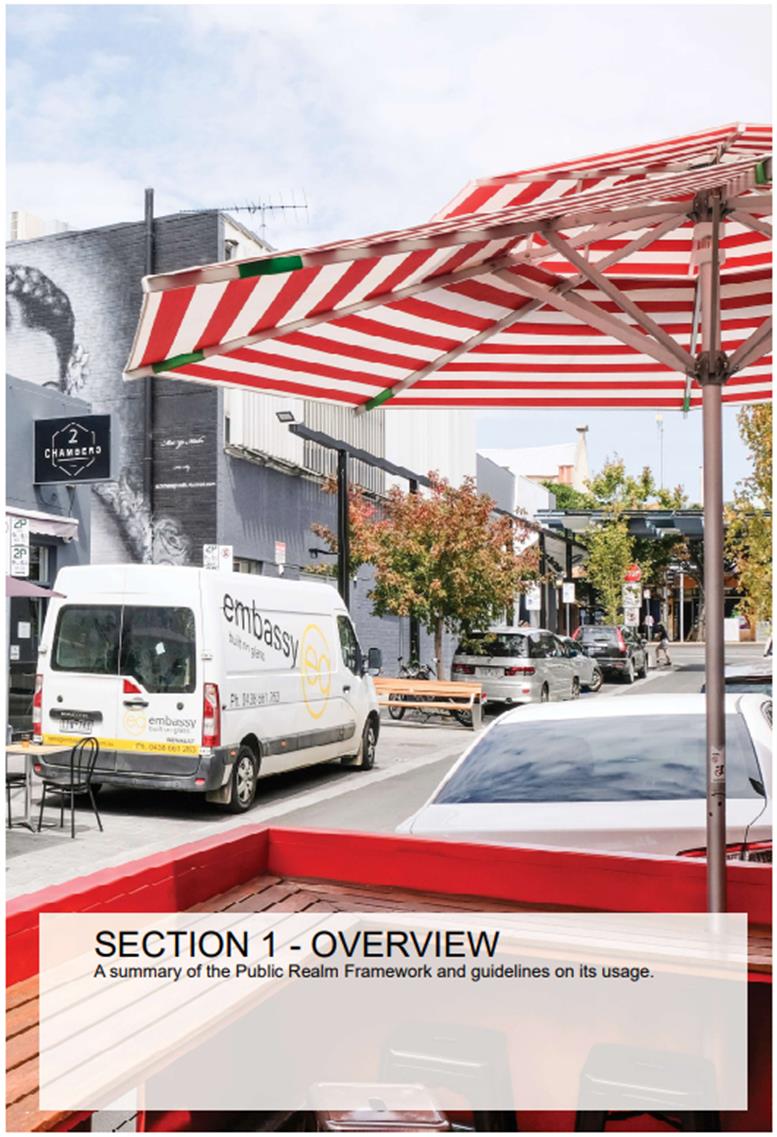
A summary of the Public Realm Framework and guidelines on its usage.
Public Realm Framework - Section 1 - Overview
- 1.1 Introduction
- 1.2 Use of the Public Realm Framework
- 1.3 Implementation (Project) Area
- 1.4 Key Principles
- 1.5 Material Composition and Combination
1.1 Introduction
Why have a public realm framework?
The Public Realm Framework (PRF) was adopted by the City of Greater Geelong Council in 2017. As part of the implementation of the Central Geelong Action Plan, it articulates Council and State Government aspirations to revitalise Central Geelong through the creation of a strong, high quality and unique identity.
What will it achieve?
The framework outlines a cohesive palette of materials, designs, finishes and furniture for the public realm and provides a guide to using the palette throughout Central Geelong.
This framework has been developed to reinforce identity and to ensure accessibility for users of all ages and abilities. Its application ensures a consistency and clarity around the design and delivery of new and revision capital works within Central Geelong, particularly in relation to the interface between private developments and the public realm.
The framework provides a design benchmark that will result in a level of cohesion for Central Geelong, while still allowing for the manifestation of unique spaces.
The framework will be implemented over time as major projects are delivererd or when routine replacement of assets or new private/public interfaces are required.
1.2 Use of the Public Realm Framework
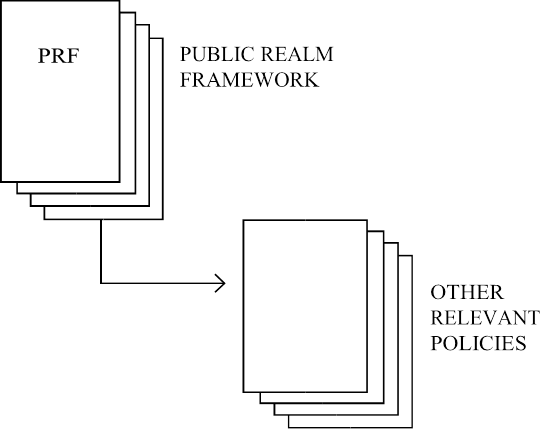
The Public Realm Framework is a set of guidelines that establishes standards for projects in Central Geelong. It provides a suite of furniture elements, material palettes and approaches to streetscape detailing, and references to other design policies.
In applying this document, users should make themselves aware of other relevant reports and strategies in place to achieve the overarching aims of the Central Geelong Acton Plan.
Reference documents
Street and Public Place Lighting Policy, 2008
1.3 Implementation (Project) Area
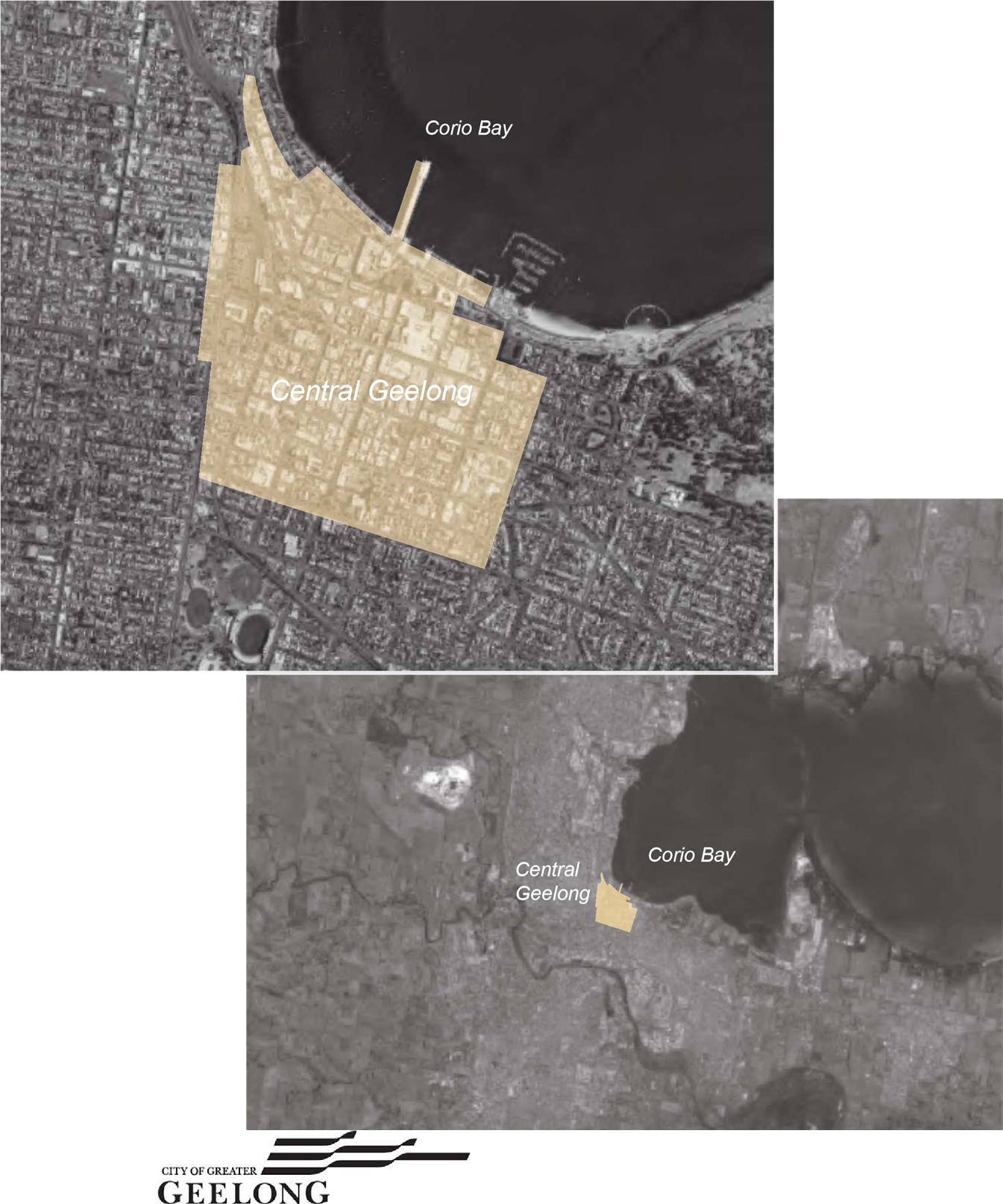
The study area includes Central Geelong as shown within the dashed boundary below. Generally the boundary extends from Latrobe Terrace to Swanston Street and from McKillop Street to Corio Bay.
1.4 Key Principles
The following key principles underpin and define the selection of materials, furniture and their application:
| Manufacturing, industrial heritage, authentic to Geelong to be translated through materials palette through restrained abstract references | The palette reflects a world class city, presenting a contemporary, refined and sophisticated aesthetic while respecting heritage and preserving character | The materials are to be resilient, sustainable, integrated and enduring and represent the distinct and unique authenticity and integrity of Geelong |
| The natural environment and green spaces are preserved and enhanced through site specific interventions | Form, textures, colours and materials works together with subtle variations to differentiate precinct characters | Central Geelong presents as a cohesive overall language with moments of ‘surprise’ along the way |
| Furniture is to be multi-use where appropriate and use custom elements to link | Art is facilitated through various platforms and provides a richness and interest to Central Geelong | The shape and form are to be seamless, clean, simple, timeless and uncluttered |
1.5 Material Composition and Combination
complementary materials that work together in any combination
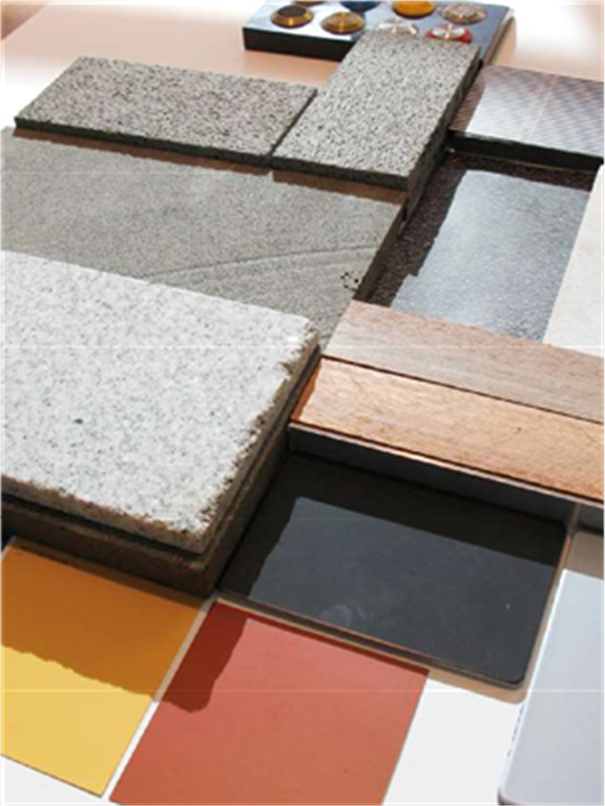
a neutral and uncomplicated ‘base’ palette that allows expression and richness through art, vegetation, bespoke elements and splashes of colour
Materials
Above is an abstract representation of the character of the materials palette, reflecting the selected materials’ texture, colour and contrast qualities. From bluestone, asphalt, refined timber, concrete and steel, the approach is of an overall cohesion with complementary and integrated materials punctuated by selective use of colour and decoration.
Central Geelong Public Realm Framework
Page last updated: