Coastal indigenous plants
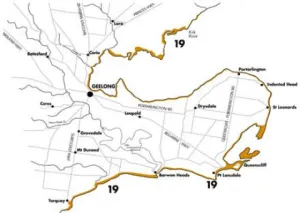
Zone 19 Consists of a variety of formations including dunes, cliffs and estuaries with the coastal processes having exposed a variety of geological types including clay, basalt, limestone etc. Vegetation distribution is to a large extent due to localised physical influences exerted by the sea, for example: salt laden winds. The average rainfall is 40 to 65 centimetres.
From Torquay to Point Lonsdale, typical dune communities of Climbing Lignum, Coast Wattle, White Correa, Coast Tea-tree, Coast Beard-heath, Coast Daisy-bush, Coast Everlasting, Cushion Bush and Dune Thistle are found along many parts of the seafront reserves.
From Point Lonsdale east around the Bay to Indented Head, scrub and woodlands occurred on sandy soils. Common tree and shrub species are Coast Daisy-bush, Coast Tea-tree, Boobialla, Coast Wirilda, Moonah, Coast Wattle and Coast Beard-heath. Drooping Sheoke is common along the cliff tops particularly on the Corio Bay side of the Bellarine Peninsula.
Generally the vegetation of the western coastline of Port Phillip Bay (St Leonards to Kirk Point) is dominated by salt tolerant species. The relatively flat topography and saline soils supports extensive saltmarshes and saline swamps and lagoons.
From Indented Head to Kirk Point, marsh grasses including Australian Salt Grass and Coast Spear-grass dominate. Associated with the salt marshes are saline swamps supporting Sea Rush and Chaffy Sawsedge sedgelands.
On the seaward edges of the salt marshes, on the beach and within the influence of high tides grows a community of Hairy Spinifex and Grey Saltbush. There are often large areas of Bower Spinach and Seaberry Saltbush along this section of the coast. Many other smaller species and grasses are indigenous to this area and are not listed in the tables on this sheet.
| Tree Species | |||||||
|---|---|---|---|---|---|---|---|
| Common name | Botanical name | Size (H x W m) | 1 | 2 | 3 | 4 | |
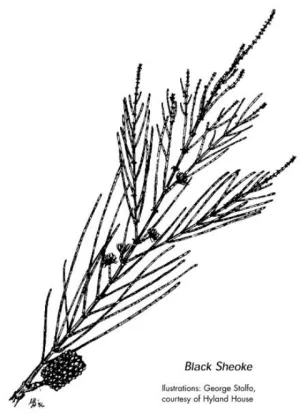
| Black Sheoke | Allocasuarina littoralis | 4-8 | 2-5 | - | - | YS | - |
Drooping Sheoke | Allocasuarina verticillata | 4-11 | 3-6 | - | YB | YC | - |
| Coast Manna Gum | Eucalyptus pryoriana | 10-15 | 10-15 | YA | - | YA | - |
| Cherry Ballart | Exocarpos cupressiformis | 3-8 | 3-5 | Y | - | - | - |
| Moonah | Melaleuca lanceolata | 1-8 | 3-6 | Y | Y | YO | Y |
| Shrub and Understorey Species | |||||||
| Hedge Wattle | Acacia paradoxa | 2-4 | 2-5 | - | YC | Y | - |
| Coast Wirilda | Acacia retinodes var. uncifolia | 4-8 | 3-5 | Y | Y | YA | - |
| *Coast Wattle | Acacia sophorae | 1-8 | 4-8 | - | YF | YF | - |
| Coast Bitter-bush | Adriana klotzschii | 1.5 | 2.5 | - | Y | Y | - |
| Dwarf Sheoke | Allocasuarina misera | 0.5 | 1-2 | - | YP | - | - |
| Sea Box | Alyxia buxifolia | 1-2 | 1-3 | - | YC | Y | Y |
| Coast Salt-bush | Atriplex cinerea | 1-2 | 2-3 | Y | Y | YG | Y |
| Coast Banksia | Banksia integrifolia | 1-10 | 1-5 | - | YTA | - | - |
| Silver Banksia | Banksia marginata | 1-10 | 1-5 | - | - | - | Y |
| Sweet Bursaria | Bursaria spinosa | 2-6 | 2-3 | - | Y | YA | YA |
| Cushion Bush | Leucophyta brownii | 0.2-1 | 2 | - | YF | Y | - |
| Common Correa | Correa reflexa | 0.3-2 | 1-2 | - | YO | - | Y |
| Coast Flax-lily | Dianella revoluta var. brevicaulis | 0.3 | 0.5 | - | Y | Y | Y |
| Rounded Noon Flower | Disphyma crassifolium | 0.5-2 | 0.1 | Y | - | - | Y |
| Silky Guinea-flower | Hibbertia sericea | 0.3-1 | 0.6 | - | YB | YB | - |
| *Coast Tea-tree | Leptospermum laevigatum | 2-8 | 2-4 | - | YI | YF | - |
| Coast Beard-heath | Leucopogon parviflorus | 1-4 | 2-3 | - | Y | YW | Y |
| Common Boobialla | Myoporum insulare | 1-6 | 3 | - | YUN | YW | YW |
| Coast Daisy-bush | Olearia axillaris | 1-2 | 1-2 | - | Y | Y | Y |
| Thyme Rice-flower | Pimelea serphyllifolia | 1-2 | 0.1-1.5 | - | Y | Y | - |
| Coast Pomaderris | Pomaderris paniculosa ssp. paralia | 1.5 | 1-1.5 | - | Y | Y | - |
| Seaberry Saltbush | Rhagodia candolleana | 2 | 1-2.5 | - | Y | YR | Y |
| Kangaroo Apple | Solanum laciniatum | 1-3 | 1-3 | YM | YC | YC | - |
| Groundcover and Tussock Species | |||||||
| Dune Thistle | Actites megalocarpa | 0.5 | 0.5 | - | Y | Y | - |
| Cranberry Heath | Astroloma humifusum | 0.5 | 1-1.5 | - | YR | YR | - |
| Karkalla (Pig Face) | Carpobrotus rossii | 0.2 | 2-3 | - | Y | Y | - |
| Australian Salt Grass | Distichlis distichophylla | 1 | 0.2 | Y | - | - | Y |
| Knobby Club-rush | Isolepis nodosa | 1.5 | 0.6-2 | Y | Y | Y | Y |
| Beaded Glasswort | Sarcocornia quinqueflora | 0.2 | 0.5 | Y | - | - | Y |
| Hairy Spinifex | Spinifex sericeus | 1-5 | 0.6 | - | Y | Y | - |
| Coast Spear-Grass | Stipa stipoides | 0.3 | 0.8 | - | Y | Y | - |
| Austral Seablite | Suaeda australis | 0.8 | 0.3-1 | Y | - | - | Y |
| Bower Spinach | Tetragonia implexicoma | 3 | 0.1 | - | Y | Y | - |
| Coast Twin-leaf | Zygophyllum billardierei | 0.3-0.6 | 1 | - | Y | Y | - |
1=Swamps and flats; 2=Dunes; 3=Point Lonsdale to Indented Head; 4=Indented Head to Kirk Point
| * These species, because of their invasive nature can become environmental weeds. Care should be taken over the selection of these species. | |||||||
| A - sheltered areas | N - Point Lonsdale dunes | ||||||
| B - behind dunes | O - on cliffs | ||||||
| C - cliffs | P - Point Lonsdale cliffs | ||||||
| D - rear dunes | R - rear dunes and protected sites | ||||||
| E - escarpment | S - sheltered cliffs | ||||||
| F - foredunes | T - Point Lonsdale | ||||||
| G - coastal fringe | U - uncommon | ||||||
| I - indigenous east of Torquay only | W - widespread | ||||||
| L - older dunes | Y - species is present in areas of remnant vegetation | ||||||
| M - well-drained and moist | |||||||
Further Contacts
- City of Greater Geelong Environment Unit: 03 5272 5272
- Department of Energy Environment and Climate Action: 136 186
- Geelong Field Naturalists Club Inc
- Corangamite Catchment Management Authority: 1800 002 262
Acknowledgements: David Perry DSE and Mark Trengove
This information sheet is also available in PDF format.
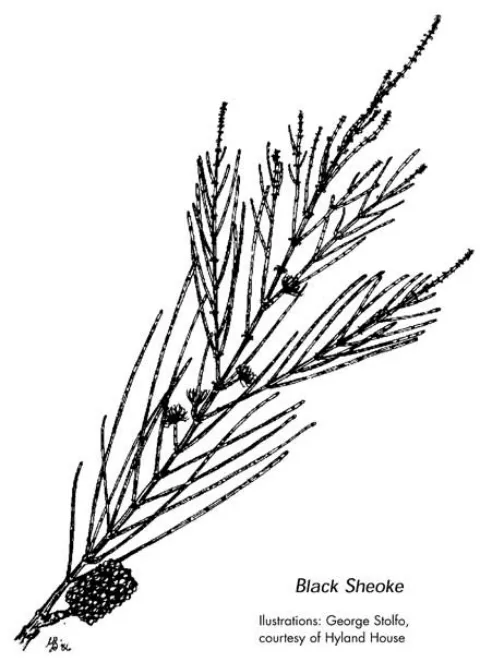
Allocasuarina littoralis 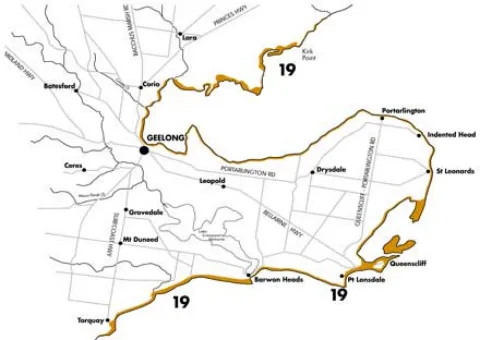
Zone 19 map