Avalon Airport comprises approximately 1,750 hectares of land, including land on long - term lease from the Commonwealth Government.
ACS - Avalon Airport Analysis
Existing operations of the airport are currently concentrated towards the northern end of the site and all flights are accommodated on the existing north-south runway, which is anticipated to meet demand for the next 20 years.
The Avalon Airport Master Plan (2015) was endorsed by the Commonwealth Department of Defence in 2015 and sets out the long-term vision for expanded operations and activities of the airport. This intended expansion will elevate Avalon Airport’s role and function as Melbourne’s second international airport.
Development of Avalon Airport is guided by four principles:
- Increasing passenger operations
- Increasing freight operations
- Increasing retail and commercial developments
- Increasing technical aviation operations.
The Master Plan is underpinned by the following objectives:
- Maintain the safe, secure and efficient movement of passengers, freight and aircraft at all times.
- Ensure airport capacity is increased and delivered on-time to accommodate forecast demands.
- Strengthen the airport’s role as a major driver of economic activity in the Geelong, Melbourne and regional Victoria region.
- Realise commercial, retail and industrial development opportunities that are compatible with on-site aviation activity to support economic development and employment creation in Victoria.
- Improve the integration of the airport with the surrounding community; and maintaining the curfew free status of the airport.
The Master Plan outlines future development plans as well as details regarding the future need for ground transport and surface access. Excluding current runways and associated taxiways, the total developable land at Avalon Airport is around 1,600 hectares. The Master Plan identifies seven developable precincts for the airport to guide its expansion and defines individual development objectives and indicative land uses into the future. For land on the airport site not designated for core airport activities, the Master Plan indicates precincts for non-aviation business, retail, commercial, and industrial facilities. The associated Land Use Plan provides details on the management and permissibility of development within the precincts.
With regard to airport activities, the Master Plan provides for the establishment of a new high capacity parallel runway (to the east of the existing north-south runway), as well as a third cross (east-west) runway to reduce conflict between general aviation activity and commercial airline and charter activity, and to accommodate aircraft during periods of strong cross winds.
While Avalon Airport has the potential to expand into the future without curfews or any other operational constraints, expansion is likely to create offsite amenity impacts through additional aircraft noise, particularly as the airport grows through the potential development of the two additional runways. Of note, the Australian Noise Exposure Concept (ANEC) contained in the current Master Plan extends directly over the township of Little River.
In 2020, Avalon Airport commissioned GHD to undertake a revised ANEC analysis of future operations. The 2020 ANEC models the second parallel runway, though does not model the third cross runway. From consultations with Avalon Airport, it is understood that the 2020 ANEC will be used to produce a new 20-year Australian Noise Exposure Forecast (ANEF) to replace the existing ANEF endorsed by the Commonwealth Government (via Airservices Australia) in 2011. While not governed by the provisions of the Airports Act 1996, conditions within the Avalon Airport lease require the preparation of an ANEF on a 20 year basis.
Following endorsement of the ANEF, an update to the Master Plan has been flagged by Avalon Airport in light of emerging strategic directions and considerations around the need for the third cross (east-west runway). Any proposal to remove the third cross runway would have to be justified on a detailed evidence base by the airport operator. The operator would also need to demonstrate that removal of the third runway would not result in any safety or efficiency implications, nor limitations to long-term capacity and growth opportunities at Avalon Airport.
However, as the potential third cross runway is included in the current endorsed Avalon Airport Master Plan (2015) – and no subsequent updates to the Master Plan have yet been formalised – the Avalon Corridor Strategy acknowledges and protects the opportunity for this runway into the future. It is recommended that all subsequent detailed planning processes for land at and around Avalon Airport should take a conservative approach on the potential development of the third cross runway. Ongoing work on an updated Master Plan will not change the overall intent of the Strategy to protect operations of the airport and the option of the third runway.
Of further relevance, Amendment VC218 (gazetted May 2022) made changes to the VPPs by updating the Planning Policy Framework to further implement the National Airports Safeguarding Framework in Victoria. Clause 18.02-7S Airports and airfields seeks to ‘strengthen the role of Victoria’s airports and airfields within the state’s economic and transport infrastructure, guide their siting and expansion, and safeguard their ongoing, safe and efficient operation.’ It contains strategies to protect airports and airfields from incompatible land use and development and lists the current Avalon Airport Master Plan (2015) as a relevant policy document.
Avalon Airport has yet to submit a revised Master Plan showing its preferred ultimate runway configuration for Commonwealth and Victorian Government approval. Any update to the Master Plan will need to be endorsed by the Commonwealth, before Minister for Planning approves a VC amendment to include it in the PPF at Clause 18.02-7S.
Following the preparation and approval of the revised Master Plan, it is recommended that an updated ANEF for the preferred ultimate capacity runway system is adopted into relevant planning schemes and additional controls are pursued, such as:
- An Airport Environs Overlay (AEO)
- Protections to address other safeguarding matters, such as public safety areas, intrusions into protected airspace and risk of wildlife strike
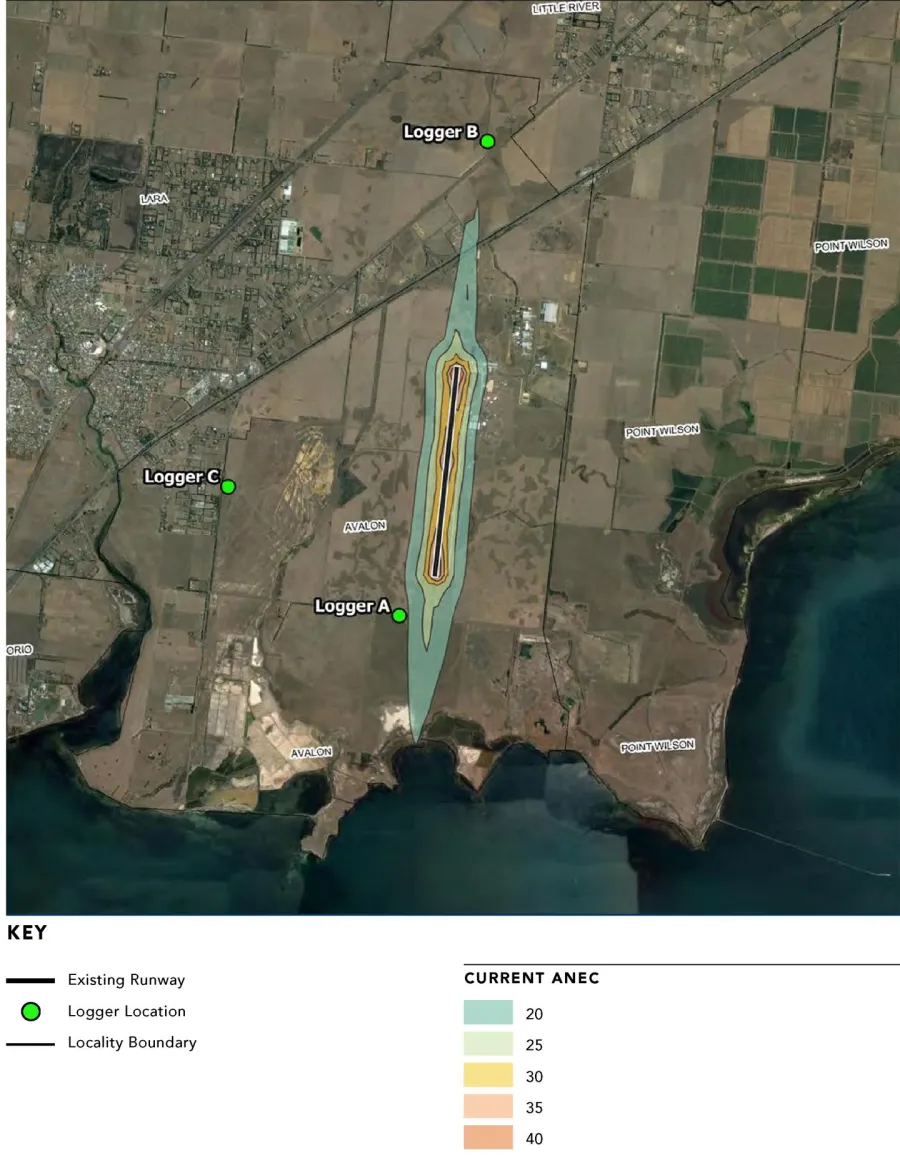
ACS - Diagram 3 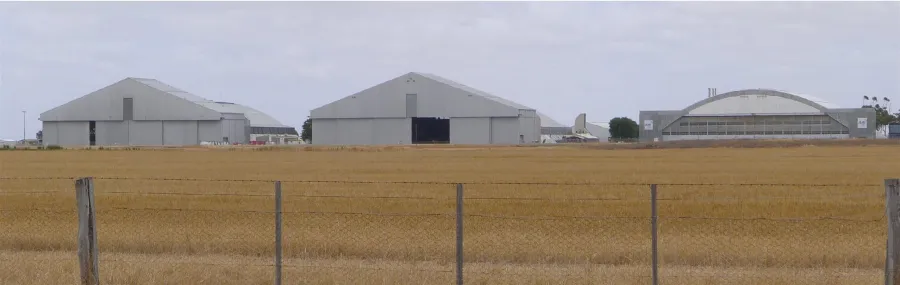
ACS - Existing aircraft hangers at Avalon Airport
Click on an image to view details and enlarge
Page last updated: