The Traditional Owners of the lands, waters, seas and skies relating to the Avalon Corridor and surrounding region are acknowledged as the Wadawurrung, who are represented by the Wadawurrung Traditional Owners Aboriginal Corporation (WTOAC) as the Registered Aboriginal Party (RAP).
ACS - Cultural values and heritage analysis
A background Cultural Values Assessment (CVA) was prepared by Unearthed Heritage and WTOAC in 2021 to inform the Avalon Corridor Strategy. The CVA was informed by the Healthy Country Plan (WTOAC 2020) which provides high-level principles values and strategies for protecting and caring for Wadawurrung Country.
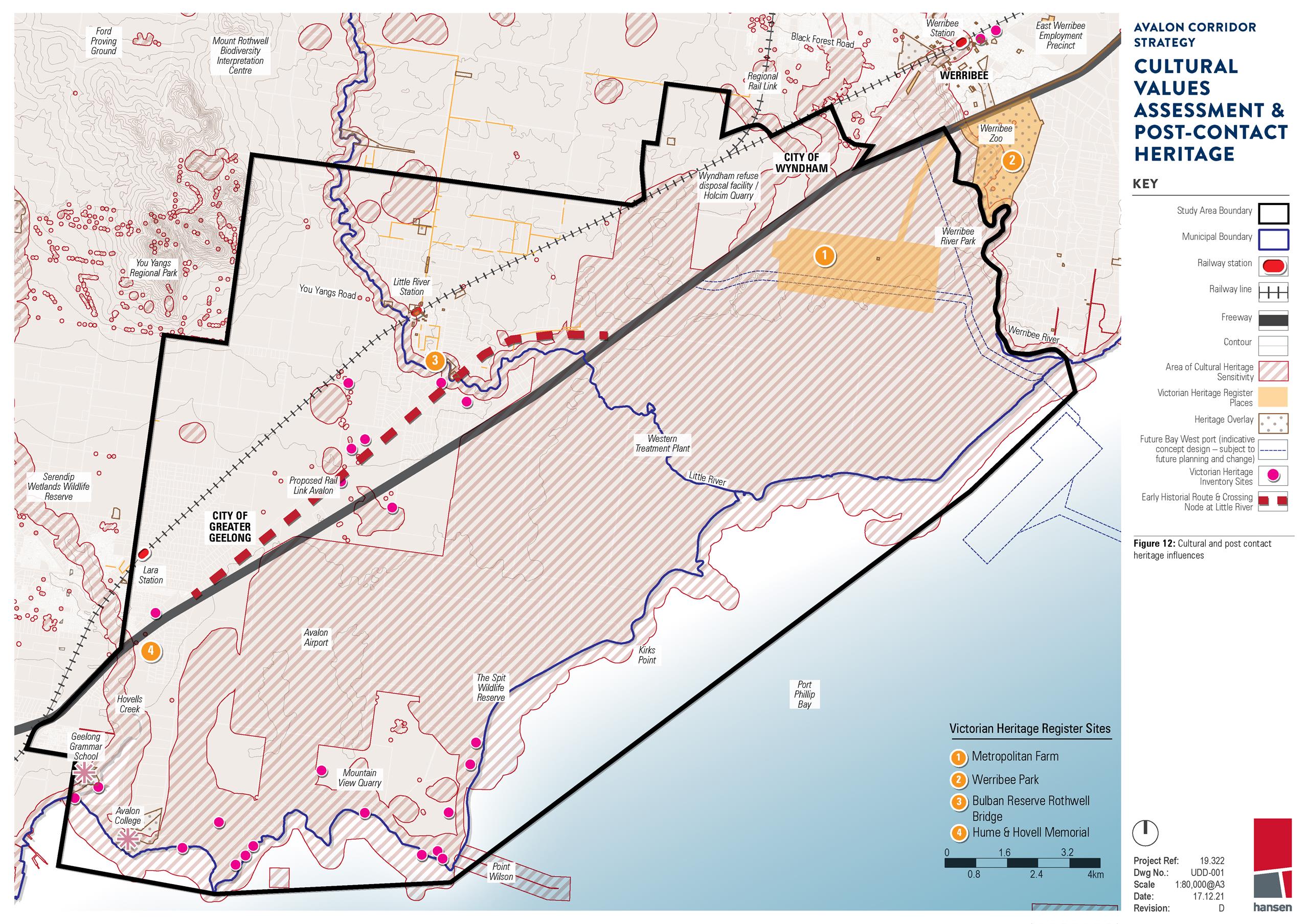
As is illustrated on Figure 12 large sections of the Avalon Corridor are nominated as being ‘areas of cultural heritage sensitivity.’ Such areas are defined in the Aboriginal Heritage Regulations (2018) (the Regulations) and relate to landforms and soil types where places of Aboriginal heritage significance are more likely to be located. This generally includes land within 200 metres of named waterways and land within 50 metres of registered Aboriginal cultural heritage sites.
The function of the designation of ‘areas of cultural heritage sensitivity’ is to specifically identify when a Cultural Heritage Management Plan (CHMP) must be prepared under the Aboriginal Heritage Act (2006).
As noted within the relevant regulations some land use and development activities are more likely to harm Aboriginal cultural heritage when carried out in an area of cultural heritage sensitivity. These activities are defined as ‘high impact activities’. If a high impact activity is proposed in an area of cultural heritage sensitivity a CHMP must be prepared before the activity can be carried out.
High impact activities generally include buildings and works that result in significant ground disturbance. The specified activities include but are not limited to:
- Subdivisions of three or more lots
- The construction of three or more dwellings
- The construction of roads bicycle and walking tracks over 100 metres in length
- Activities that require an Earth Resources Authorisation
- Industrial developments.
Given that large tracts of the Avalon Corridor are considered areas of cultural heritage sensitivity including the Avalon Airport site and surrounding land future land use change and development applications for high impact activities would need to undertake more detailed analysis and site investigations to address the requirement for the preparation and development of a CHMP.
Unearthed Heritage were commissioned to undertake a Cultural Values Assessment (CVA) of the Avalon Corridor. The aims of this assessment were:
- To determine the level of previous Wadawurrung and Aboriginal heritage investigation of the study area and the surrounding region in partnership with WTOAC.
- To determine the presence of registered Wadawurrung and Aboriginal heritage places within the study area and the surrounding region.
- To determine the environmental context of the study area.
- To review the historical and cultural setting of the study area and surrounding region.
In addition to tangible aspects of Wadawurrung and Aboriginal cultural heritage in the Avalon Corridor the assessment also considered less tangible living cultural values and narratives inherent in the landscape.
High level recommendations of the CVA are provided in full below (with further detailed recommendations included within the CVA itself):
- The WTOAC/RAP supports and recognises the merits in ensuring that the Avalon Corridor retains its non-urban character and that no future residential developments be permitted outside of existing zoned lands for that purpose. Thus the WTOAC/RAP recommends that residential development is contained within in existing locations with no further extensions to developable land in Lara or Little River. WTOAC/RAP recommends that all industrial or commercial development should be contained to appropriate areas immediately adjacent to Avalon Airport subject to thorough investigation of potential impacts on Wadawurrung living cultural heritage and the natural and avian environment.
- The WTOAC/RAP recommends that any future planning scheme amendment or land use or development inside the Corridor needs to embody statutory provisions that require respect of the unalienable spiritual and visual relationship that Wurdi Youang has upon this living cultural landscape that stretches across the Avalon Plain to the shores of Nerm (Port Phillip Bay). Thus any future development needs to respect and consciously engage with and be assessed against this relationship.
- The WTOAC/RAP supports maintaining the current nature of statutory and strategic planning instruments and provisions over this Corridor but would recommend the strengthening and enhancement of these provisions (including VPP 42.01 Environmental Significance and VPP 42.03 Significant Landscape and the associated Schedule 1 to Clause 42.03 provisions) and their geographical scope to better respect and conserve Wadawurrung Country values and lands and waters attributes (including cultural flows environmental management of vegetation and water systems visual connections and cultural landscapes migratory and inter-tidal bird habitats and unrecorded sites of Wadawurrung cultural heritage).
- The WTOAC strongly supports and raises as a matter of urgency that an Aboriginal Cultural Heritage Impact Assessment be undertaken for the foreshore corridor from the mouth of Werribbi Yulluk (Werribee River) down to Point Wilson to better assess appraise and identify resilience measure to prevent future negative impacts to existing Wadawurrung tangible cultural heritage sites and places along this corridor and especially to provide evidence to underpin an ecosystem-based adaptation response to sea level rise from climate change.
- The WTOAC strongly supports the current Melbourne Water ethos in carefully managing its fragile ecosystems to enable and support existing and future bird and animal communities and also ensuring the conservation of extant vegetation communities that possess integrity of species mosaic and host known rare endangered and vulnerable species.
- The WTOAC invites co-design opportunities with all proponents and project designers to enable the above Recommendations and any opportunities for Wadawurrung to be afforded employment experience associated with the project’s further design construction and operation.
The above recommendations of the CVA have informed the preparation of the Avalon Corridor Strategy. Some recommendations are beyond the scope of the Strategy to address and require further investigation through subsequent processes including:
- Further detailed investigation into potential expansion of the SLO to address matters of cultural value including consideration of whether the SLO is the most appropriate planning scheme tool (refer to Recommendation C).
- The completion of an Aboriginal Cultural Heritage Impact Assessment and/or CHMP for land use change and development proposals (refer to Recommendation D).
Based upon a number of studies undertaken by WCC and CoGG and public consultation on the draft report the post contact heritage values of the Avalon Corridor centre around four themes:
Exploration colonisation and dispossession
Point Wilson is believed to be in the vicinity of where the expedition of Hamilton Hume and William Hovell reached the southern coast of Australia in 1824 after setting out from Yass in NSW. This feat of European exploration is significant to Aboriginal peoples and Europeans. For Europeans the expedition opened up southeast Australia to colonisation and settlement and the Australian-born Hume was a remarkable bushman who guided the expedition utilising traditional bush skills he had learned amidst the Dharawal people of NSW. For Aboriginal peoples the expedition is a symbolic catalyst for the invasion and dispossession of traditional lands across southeast Australia.
Whilst peripheral to this Strategy it should be recognised that the management of the memory and physical manifestations of that event needs to be handled with sensitivity and respect including future management of the registered Hume and Hovell Centenary Memorial (VHR H1547) on the fringe of Lara and the current application of the name Hovells Creek to the traditional waterway discharging into Limeburners Bay.
Little River is a residential and farming community on the western boundary of WCC and takes its name from the deep river that flows from the Brisbane Ranges to the sea near Lake Borrie. The river is slightly smaller than the Werribee hence its name. In early days of settlement the road from Melbourne to Geelong had a crossing at Little River. The Traveller’s Rest Inn was built in 1839 and a post office was opened in 1858. Lot 14 one of the Port Phillip Association’s first allotments was taken up by pioneer James Simpson. Little River later became part of the vast Chirnside empire. When the Geelong to Melbourne railway opened in 1876 bluestone station buildings and goods sheds were constructed.
Little River became an important hub for local farmers graziers and haycarters who used the railway to carry their goods to markets in both Geelong and Melbourne. The line is still heavily used today carrying commuters in both directions.
Transport and utilities
The heritage values of the registered former Metropolitan Farm (VHR H2400) at WTP need to be conserved for their significance as a major early civil engineering feature. Early related structures from the farm may also occur within the surrounding coastal foreshore area. Where practicable these should be left in place and conserved if still in use or left as redundant structures or ruins if not.
The Old Melbourne Road that runs through Little River delineates the general route of one of the earliest European tracks within Victoria. Running between Melbourne and Geelong from the mid-1830s Old Melbourne Road developed into a major road over the following decade. The crossing of this route over the Little River at Rothwell formed a key stopping place at which the Traveller’s Rest Inn was developed in 1839.
The Rothwell Bridge was later built to replace the adjacent ford. The heritage value of the registered Rothwell Bridge (VHR H1454) needs to be conserved and the historical and archaeological importance of this crossing place requires further investigation along with potential shared values as a camp and crossing place for Wadawurrung Traditional Owners.
Secondary transport features on the Victorian Heritage Inventory (VHI) include a number of coastal jetties and trig stations. These are reasonably protected within the coastal foreshore reserves but may warrant further investigation.
Avalon Airport is not considered to be of heritage significance at this time though may take on some historical or social significance in the long term as Melbourne’s second airport and the home of Australia’s major airshow.
Resource harvesting
The landscape between the Princes Freeway and the base of Wurdi Youang (the You Yangs) is predominantly a pastoral landscape divided into rectilinear blocks by fencelines tree plantings and remnants of dry stone walls. There are a number of Heritage Overlay (HO) farm homesteads and complexes which need to be conserved for their heritage value. The historical and archaeological significance of dry stone walls south of Little River requires further investigation.
Secondary natural resource harvest areas include the former Cheetham Saltworks adjoining Avalon Airport which are included on the VHI and may warrant further investigation prior to any redevelopment. The lime burning kilns on the foreshore adjoining Geelong Grammar also on the VHI may warrant investigation should they be at risk of disturbance. There are a number of minor recreational fishing sites included on the VHI which are of no special significance but may also warrant investigation prior to any disturbance.
Education
Geelong Grammar is located on the southern edge of the study area and is protected under a HO. Nature based research and education associated with the Port Phillip foreshore is the subject of increasing social and educational importance to the community. These values are generally protected under the Natural Resource Management policies for the area and do not. Some smaller reservations along water courses in the Avalon Corridor are also of heritage significance including two are protected under HOs at Little River.
Beyond the above themes significant post contact aesthetic and social values complement Wadawurrung cultural values relating to natural heritage of the native bushland of the You Wurdi Youang (the You Yangs). Wurdi Youang has importance to the wider community as one of the two most significant natural landmarks within Greater Geelong with the other being Corio Bay. Community consultation also indicates they possess wider aesthetic significance as a backdrop to the pastoral landscape between Lara and Little River.
Municipal heritage studies undertaken by CoGG and a Heritage Review (Gap Study) undertaken by WCC in 2019 have identified a number of historical sites that have the potential to meet the threshold for protection under HOs. Both CoGG and WCC are proposing to undertake further investigation of these sites over the next 5 years. The WCC gap study has identified 15 potential HO places within the study area relating primarily to residential and non-residential (community commercial industrial military and landscapes) themes within
settlement areas.
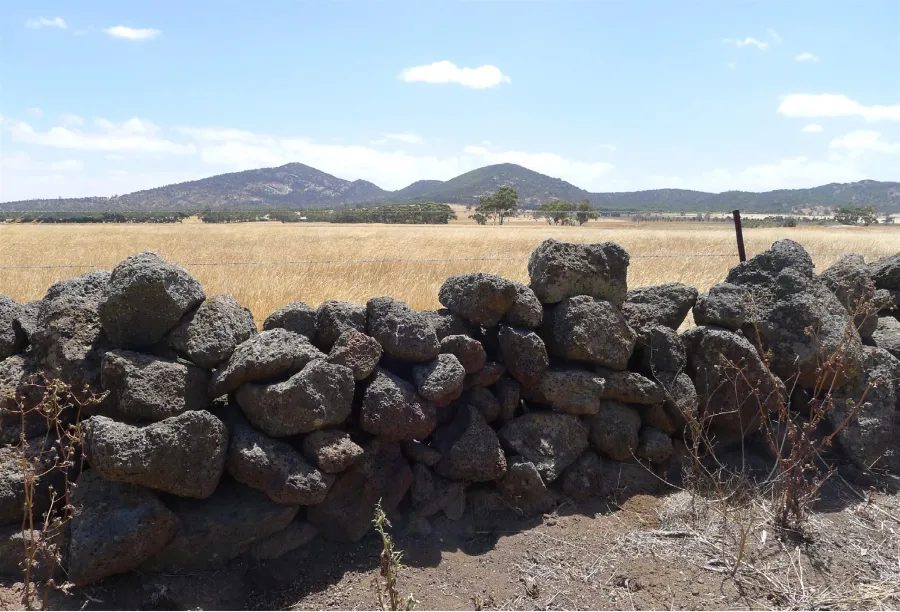
ACS - heritage stone walls 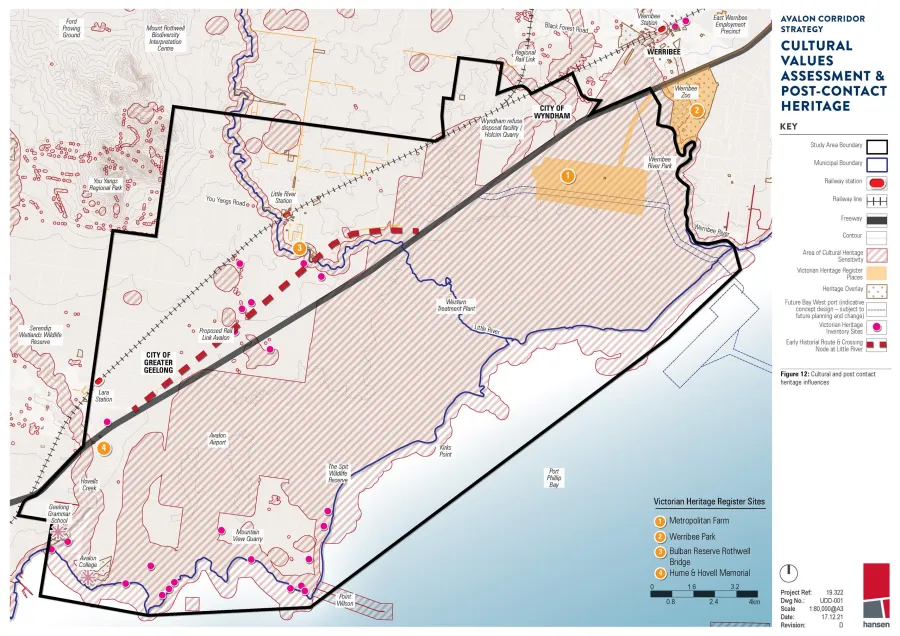
ACS - Figure 12
Click on an image to view details and enlarge
Page last updated: